Yes, you can get a mortgage when you are self-employed. You meet the same core standards as any borrower: credit, savings and stable income. The difference is how that income is proven. Instead of a pay stub, a lender reads your tax returns and business records, and the figure that counts is the income left after your deductions. This guide explains what lenders look for, which documents to gather and which loan types fit different situations.
TL;DR
- Most lenders want two years of consistent self-employment, though a shorter history can work with strong documentation.
- Expect to provide personal and business tax returns, a year-to-date profit and loss statement and bank statements.
- Heavy tax write-offs lower the income a lender can count, which can raise your debt-to-income ratio.
- Conventional, FHA and VA loans are open to self-employed buyers. Bank statement and other non-QM loans exist for income that tax returns understate.
- Start preparing your paperwork before you shop for homes, not after you make an offer.
Table of Contents
- Who counts as self-employed
- How hard is it really?
- Self-employed mortgage requirements
- How lenders calculate your income
- Documents to gather
- How the process works
- Loan options for self-employed borrowers
- How to strengthen your application
- Our perspective
- Start with a plan, not a rejection
- FAQ
- Sources
Who counts as self-employed
Lenders use a specific test. Under Fannie Mae’s Selling Guide, anyone with a 25% or greater ownership interest in a business is considered self-employed. That covers sole proprietors, freelancers, independent contractors paid on a 1099, partners and owners of S corporations and LLCs.
If self-employment is only a side income and you qualify on your salary alone, the full self-employed analysis generally does not apply to you. If your business income is needed to qualify, it does.
How hard is it really?
It is not a different set of rules, but it is more paperwork. Self-employed borrowers can qualify by showing consistent income over time, and proving that income may take extra documentation. A Guild Mortgage operations officer told Bankrate that the basic approval criteria are the same for everyone: good credit history, enough liquid assets and stable employment history.
Where self-employed buyers tend to struggle is not eligibility but presentation. A strong business with messy records, or a profitable one with aggressive deductions, can look weaker on paper than it is.
Self-employed mortgage requirements
Two years of history
Fannie Mae generally requires lenders to obtain a two-year history of prior earnings to show the income is likely to continue. Freddie Mac’s consumer site says the same: most lenders require at least two years of consistent self-employment in the same industry.
There are exceptions in both directions:
- Less than two years. A shorter history may be considered if your tax returns show a full year of income from the current business and your documentation supports prior income at the same or a higher level in the same or a similar field.
- A previous W-2. If you have not been self-employed for two full years, lenders may accept a W-2 from a previous employer alongside business documents.
- Established businesses. Fannie Mae allows a lender to accept only one year of personal and business returns when the business has existed for five years, you have held at least 25% ownership for those five years, and the lender completes a cash flow analysis.
Credit score and down payment
Minimums depend on the loan type. According to Bankrate, conventional mortgages require at least 3 percent down and a 620 credit score, FHA loans 3.5 percent down with a score of 580, and VA loans usually need no down payment. Individual lenders often set higher thresholds, and the best pricing goes to stronger scores.
Cash reserves
Savings matter more when income swings. Experian notes that six months of expenses in savings reassures lenders you can handle an income disruption. Reserves are not always a fixed requirement, but they strengthen almost every file.
The business itself
Lenders do not only look at you. Fannie Mae’s guide tells them to analyze the stability of your income, the location and nature of the business, the demand for its product or service, its financial strength and its ability to keep producing income. A plumbing contractor with steady repeat clients and a consultant with one remaining customer read very differently.
How lenders calculate your income
This is the step that surprises most self-employed buyers. Lenders do not start from what your business brings in. They start from what your tax returns show after expenses.
Bankrate quotes a mortgage CEO explaining that self-employed people often use every legal deduction, so they often show a low net income or even a loss on their returns. Freddie Mac adds that debt-to-income is calculated on income after expenses, so lowering your tax bill with deductions can raise your DTI.
A simplified example: your business collects $180,000 in revenue and you deduct $95,000 in legitimate expenses, leaving $85,000 of net profit. The lender works from the $85,000, then reviews trends across two years. If the second year is lower than the first, the lender may average the two or use the lower figure, depending on the loan program.
Lenders also look at business debt. Under Freddie Mac’s guide, the lender must analyze notes payable in less than one year and decide whether income should be reduced by that debt, considering the business’s liquidity and whether a line of credit is consistently renewable.
Two practical takeaways:
- Talk to your CPA before you decide how much to deduct in the one or two tax years before you plan to buy.
- If your tax returns understate what you really earn, a lender can point you toward a program built for that situation (see the options below).
Documents to gather
Fannie Mae’s consumer page lists two years of tax returns, 1099 forms for contract work, profit and loss statements or business tax returns, and a business license for self-employed applicants, plus asset statements for checking, savings, retirement and business accounts. Freddie Mac’s guidance adds two years of business returns including K-1, 1120 and 1120S schedules, a year-to-date profit and loss statement and a balance sheet.
| Document | Why a lender asks for it |
|---|---|
| Two years of personal tax returns | Shows your reported income and its trend |
| Two years of business returns (K-1, 1120, 1120S where they apply) | Shows the business’s own performance |
| Year-to-date profit and loss statement | Covers the months since your last filed return |
| Balance sheet | Shows the business’s assets and liabilities |
| 1099 forms | Documents contract income |
| Business license, CPA letter, client letters, proof of business insurance | Confirms the business is real and ongoing |
| Bank and asset statements | Shows down payment, closing funds and reserves |
Freddie Mac suggests that if your history is short, letters from current clients, a signed CPA statement, a business license and proof of business insurance help show consistency. Our mortgage document checklist walks through what to prepare before you start touring homes.
Keep personal and business finances separate. Clean business bank accounts make any income analysis faster, whatever program you use.
How the process works
The steps look like a regular purchase, with a heavier income review.
- Pre-review your file. Before applying, a loan professional looks at your returns, credit and assets and tells you which programs fit and what price range is realistic.
- Get pre-approved. You submit documents, authorize a credit check and receive a letter you can attach to offers.
- Shop and make an offer. Your pre-approval sets your budget, so keep your business deductions and credit activity stable while you shop.
- Underwriting. The underwriter reviews your income analysis, may ask for explanations of large deposits, gaps or declines in income, and orders the appraisal.
- Close. Avoid new debt, large purchases or moving money between accounts without documenting it until the loan funds.
Respond to underwriter requests quickly. Self-employed files often generate a few extra questions, and fast, complete answers keep your closing date intact.
Loan options for self-employed borrowers
The right loan depends on how your income looks on paper.
| Situation | Loan type to consider |
|---|---|
| Two years of solid, well-reported income | Conventional, FHA or VA |
| Large loan amount | Jumbo loan |
| Tax returns understate real earnings | Bank statement loan or P&L loan |
| Significant savings or investments but irregular income | Asset depletion loan |
| Buying a rental property | Investment property financing or a DSCR loan |
| Non-U.S. citizen without a Social Security number | ITIN loan |
Agency loans
When your returns support the income you need, conventional, FHA and VA loans are often the most affordable route. The credit and down payment minimums above apply, and agency guidelines set the documentation rules. Browse the full range on our loan programs page.
Bank statement and other non-QM loans
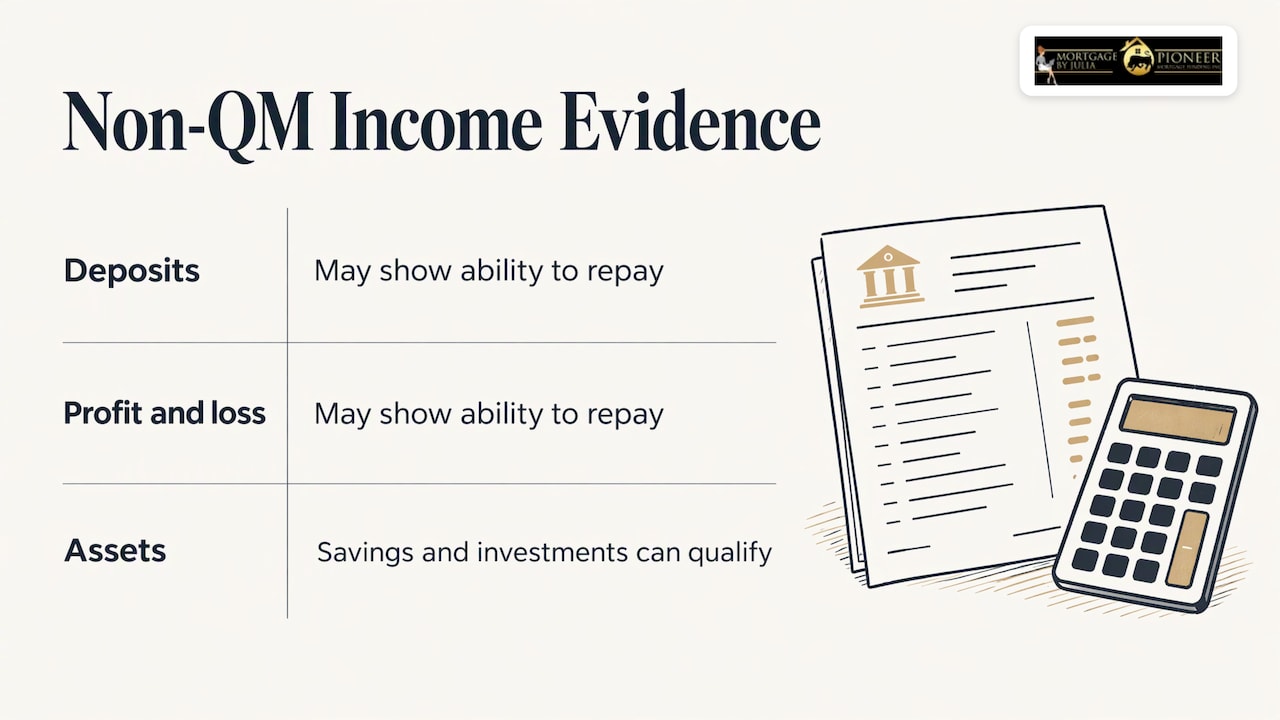
Non-QM loans follow different underwriting rules. Bankrate describes them as offering more underwriting flexibility and sometimes a unique structure, such as a bank statement loan. Instead of focusing only on net taxable income, these programs may use deposits, a profit and loss statement or assets to show your ability to repay. Our guide to how non-QM mortgages work explains who qualifies, and the asset depletion mortgage guide covers using savings and investments as qualifying income.
Terms for these programs vary by lender, so a side-by-side comparison matters more here than anywhere else.
How to strengthen your application
- Keep your credit tight. Pay down revolving balances and avoid new accounts in the months before applying.
- Build reserves. Aim for several months of living and housing expenses in accessible accounts.
- Plan your deductions. Ask your CPA how your filing strategy will affect mortgage qualification, ideally two tax years ahead.
- Show the trend. Steady or rising income carries more weight than a high figure in only one year.
- File on time. Lenders need filed returns, so late or amended filings can delay a loan.
- Document your history. If you are under two years in, gather prior W-2s, client letters and evidence of experience in the same field.
Our perspective
Self-employed buyers rarely have a qualification problem. They have a matching problem. The same borrower can look marginal to one lender and straightforward to another, because each program reads income differently.
That is why we work with a broad range of lenders instead of a single set of guidelines. After more than 20 years in banking and finance and over $350 million in closed loans, we have seen that the first step is understanding how your income will be read: through tax returns, bank deposits, a profit and loss statement or assets. Once that is clear, we match you with the program and lender that fit your numbers.
We also see how often self-employed and international clients are told no too early. A clear conversation, a well-organized file and the right program often turn that around. Our job is to explain each option plainly, so you decide with full information.
Julia Zhguleva
Start with a plan, not a rejection
If you are self-employed and buying or refinancing in Florida, we can review your income, explain which programs match your situation and take care of the lender matching. We work with homebuyers, investors, international buyers and business owners across South Florida. Start on our home purchase and refinance page.

If you are comparing programs first, our loan programs overview lays out the choices.
FAQ
Can I get a mortgage if I have been self-employed for less than two years?
Often yes, though your documentation matters more. Fannie Mae’s guidelines allow a shorter history when tax returns show a full year of income and records support prior income at the same or higher level in a similar field. A previous W-2 can also help. Some non-QM programs use different history requirements.
Can 1099 workers get a mortgage?
Yes. Independent contractors are treated as self-employed when they meet the ownership test, and lenders use 1099 forms along with tax returns to document income. Expect the lender to review your net income after business expenses, not only the 1099 totals.
What credit score do I need?
It depends on the program. Bankrate reports minimums of 620 for conventional loans and 580 for FHA loans with 3.5 percent down. Lenders may require more, and higher scores generally earn better pricing.
What if my tax returns show low income because of write-offs?
A lender can only count the income your returns show under standard programs, which can raise your DTI. Options include waiting for a year with fewer deductions or looking at bank statement, P&L or asset-based programs, which evaluate income differently.
Is a bank statement loan right for me?
It can be when your deposits and business cash flow show stronger earnings than your tax returns do. These are non-QM loans, so rates, down payments and terms differ from agency loans. Reviewing your situation with a broker who can compare several lenders helps you see the trade-offs.
Sources
- Underwriting Factors and Documentation for a Self-Employed Borrower, Fannie Mae Selling Guide
- Documents you need to apply for a mortgage, Fannie Mae
- Qualifying for a Mortgage When You’re Self-Employed, Freddie Mac My Home
- Seller/Servicer Guide, Section 5304.1, Freddie Mac
- How To Get A Mortgage When Self-Employed, Bankrate
- How to Get a Mortgage When You’re Self-Employed, Experian