
An asset depletion mortgage lets you qualify for a home loan using your savings, investments or retirement accounts instead of a paycheck. The lender converts your eligible assets into a monthly income figure, then uses that figure in the usual debt-to-income test. It suits retirees, business owners, investors and international buyers whose wealth is larger than their documented income.
TL;DR
- Lenders divide your eligible assets by the loan term in months to create qualifying income. You do not have to sell the assets.
- Fannie Mae allows a version for purchases and limited cash-out refinances, with a maximum loan-to-value of 70%, or 80% if the asset owner is 62 or older.
- Non-QM lenders write more flexible versions, with their own discounts on asset values, reserves and down payment rules.
- Different terms mean the same thing: asset depletion loan, asset-based mortgage, asset qualifier mortgage and asset dissipation loan.
- Qualifying on assets is not a spending plan. Taxes and market swings still apply to the money you draw.
Table of Contents
- What an asset depletion mortgage means
- How lenders turn assets into income
- Which assets count
- Requirements at a glance
- Who this loan fits
- Costs and risks to plan for
- Agency or non-QM: how to choose
- Talk to us about your options
- FAQ
- Sources
What an asset depletion mortgage means
The product has several names. Banks and regulators often say asset dissipation underwriting. The U.S. Office of the Comptroller of the Currency defines asset dissipation underwriting as using an applicant’s assets to calculate a hypothetical cash annuity stream, which is then added to any other income. The same bulletin notes that this method is often used for high-net-worth applicants who hold significant liquid assets but lack the cash flow to meet standard income tests.
So “asset depletion mortgage,” “asset depletion loan,” “asset-based home loan” and “mortgage based on assets” describe one idea. What differs is the rulebook: an agency version run under Fannie Mae guidelines, or a non-QM version written by a private lender.
How lenders turn assets into income
The core arithmetic is simple. Under Fannie Mae’s Selling Guide, the lender divides your net documented assets by the loan’s amortization term in months. Net documented assets are your eligible assets, minus any penalty for a full distribution and minus the funds you need for the down payment, closing costs and required reserves.
A worked example
Fannie Mae’s own example uses a $500,000 IRA with a 10% early-distribution penalty and $100,000 set aside for closing funds. That leaves $350,000 in net documented assets. Divided by 360 months on a 30-year loan, the qualifying income is $972.22 per month.
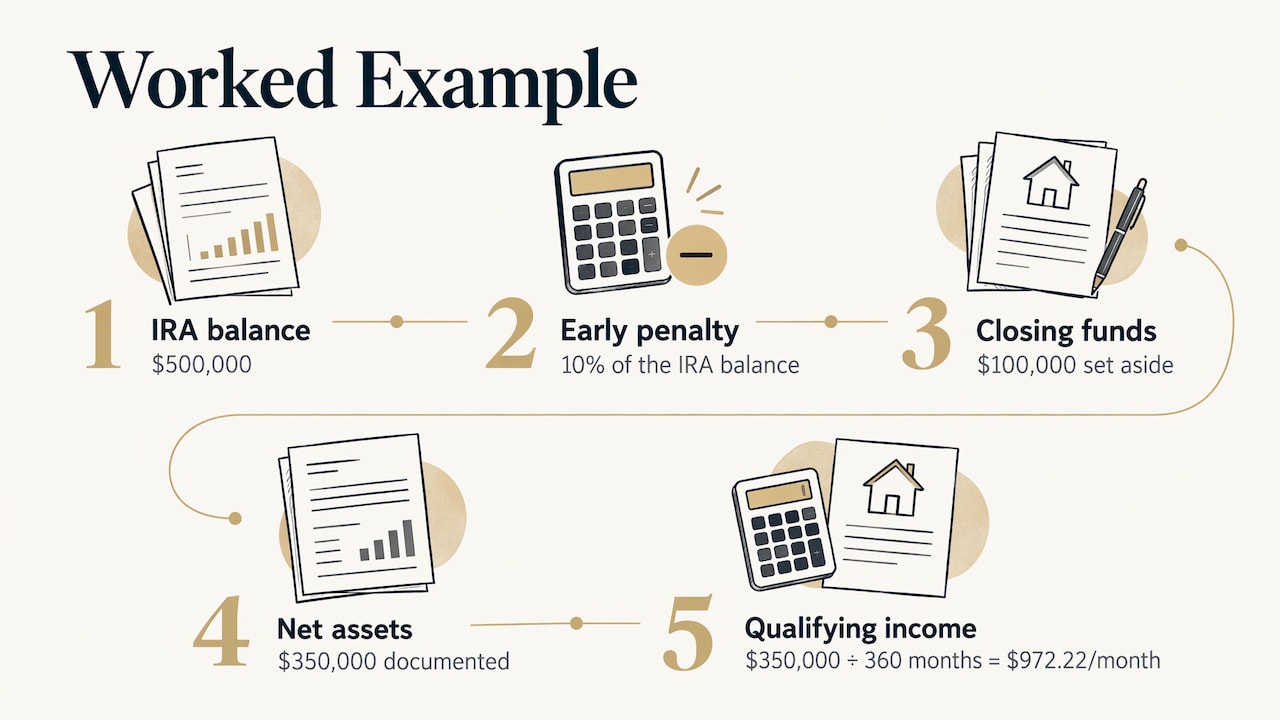
That monthly figure goes into your income line. It is added to any other income you document, such as Social Security, a pension or rental income, and then your total debts are compared to it.
Why the loan term matters
A longer term spreads the same assets over more months, so the monthly figure is smaller. A 15-year loan has a larger monthly depletion number but also a larger payment. Run both against your numbers before you choose. Our mortgage calculator for Florida buyers shows the payment side of that comparison.
Which assets count
The answer depends on the program.
Agency rules (Fannie Mae)
Fannie Mae accepts employment-related assets: 401(k), IRA, SEP and Keogh accounts where you have unrestricted access, plus non-self-employed severance packages and lump-sum retirement distributions. Checking and savings generally do not count unless they were funded from one of those eligible sources. The same guide lists what is ineligible: stock options, non-vested restricted stock, lawsuits, lottery winnings, real estate sale proceeds, inheritance, divorce proceeds and virtual currency.
Assets must be owned by the borrower alone, or the co-owner must be a co-borrower on the loan. The documentation must meet Fannie Mae’s allowable age requirements. No minimum income history is needed, and you do not have to show that the income will continue, because it is calculated from the loan terms.
Non-QM programs
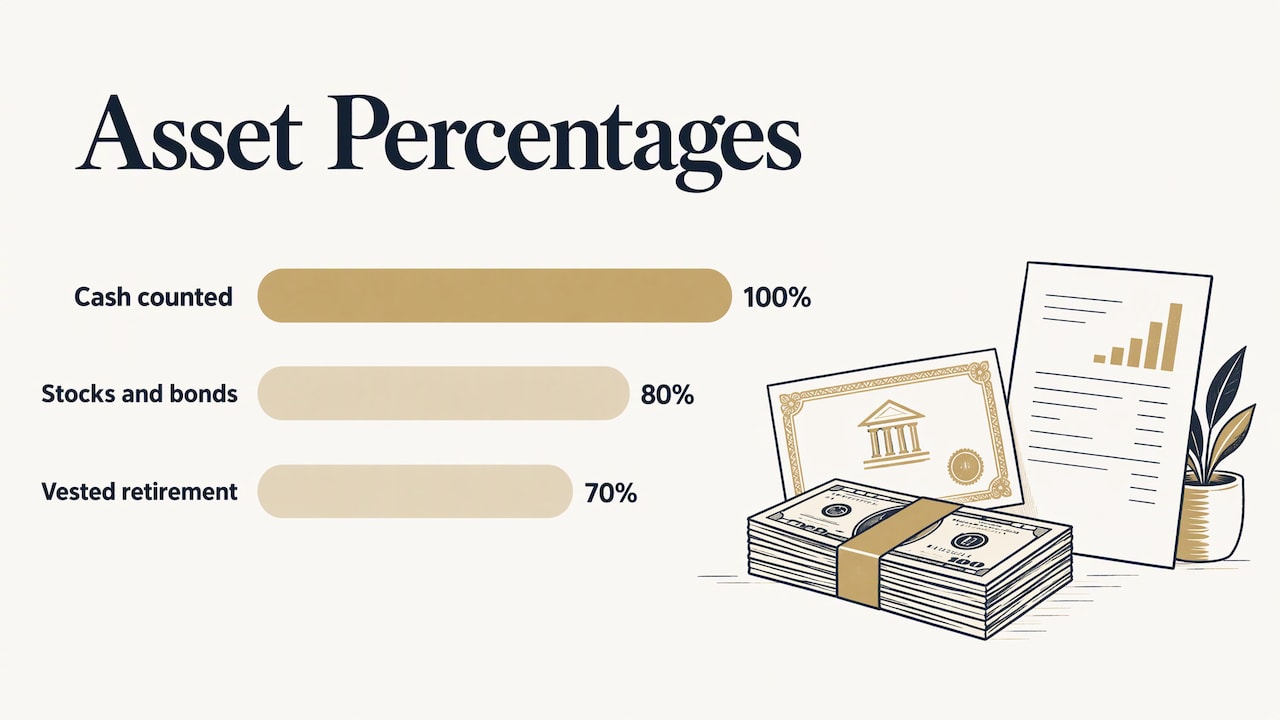
Private lenders set their own guidelines and usually accept a broader mix, including brokerage accounts, stocks, bonds and cash. Many apply a percentage discount to reflect market volatility. Industry summaries commonly cite figures such as 100% of cash, 80% of stocks and bonds, and 70% of vested retirement balances, with minimum qualifying assets often between $500,000 and $1 million. These are benchmarks, not fixed rules. Each lender publishes its own, and they change.
The OCC expects lenders using this method to have written policies on eligible assets, discounts, verification of ownership and current value, assumed rates of return and the dissipation period. That is why two lenders can give you different income numbers from the same statements.
Requirements at a glance
| Item | Fannie Mae agency version | Typical non-QM version |
|---|---|---|
| Loan purpose | Purchase or limited cash-out refinance | Purchase and often refinance |
| Occupancy | Principal residence or second home | Often includes investment property |
| Max LTV | 70%, or 80% if asset owner is 62+ | Set by lender, often a larger down payment |
| Assets | Employment-related retirement and severance assets | Broader: cash, brokerage, retirement |
| Asset discounts | Penalties and costs deducted | Lender-specific percentage discounts |
| Income history | None required | Lender-specific |
On the non-QM side, one 2026 guide describes typical credit scores of 700 or higher, down payments around 20% to 30%, and reserves of 3 to 12 months. Treat that as a rough picture only. Your actual terms depend on the lender and loan size.
Reserves matter on any program. Fannie Mae’s reserve rules count liquid accounts and vested retirement savings, but not non-vested stock options or unsecured personal loans.
Who this loan fits
Retirees
Retirees often have large IRAs or 401(k) balances but modest taxable income. The Fannie Mae route works well for them, and the 80% LTV limit at age 62 is a real advantage over the 70% limit.
Self-employed borrowers
Tax returns for business owners often show low net income after deductions. If you hold significant liquid assets, asset depletion can replace or supplement that income. If your cash flow is strong but your returns are not, a bank statement loan or a P&L loan for self-employed borrowers may fit better. Some borrowers combine approaches, so ask which one produces the strongest result.
Real estate investors
If the property will produce rent, a DSCR loan qualifies the property on its own income and may be simpler. Asset depletion helps when you want to qualify personally. See our page on investment property financing for the options.
International buyers
Foreign buyers often hold wealth outside the U.S. and have no U.S. income history. Agency loans are built around U.S. documentation, so non-QM programs are usually the practical route. Lender rules on where assets may be held, how they are verified and whether funds must be moved vary, so raise this at the start.
Costs and risks to plan for
Asset depletion is a qualification tool, not a budget. As one analysis explains, if you qualify on a $2,200 monthly depletion figure and actually sell appreciated stock to cover $2,200 in payments, you net less after taxes. Underwriting will not build that gap into your personal plan, so do it yourself, ideally with your tax adviser.
Other points to plan for:
- Down payment. Lower LTV limits mean more cash at closing. Under Fannie Mae’s 70% cap, you need at least 30% down on a purchase.
- Retained assets. The assets you qualify on generally must remain after closing. Do not move or spend them mid-process.
- Market value changes. Stocks and funds fluctuate, so lenders typically verify current balances close to closing.
- Pricing. Non-QM loans can carry different rates and fees than agency loans. Compare offers on the same loan term.
Agency or non-QM: how to choose
- List your assets by type: retirement, brokerage, cash, business, real estate.
- Check how much is employment-related retirement money, since that is what Fannie Mae counts.
- Estimate your down payment and reserves, so you know your net documented assets.
- Compare the agency result with a non-QM result. A broker who works with many lenders can price both.
- Check the monthly payment against your actual cash plan, including taxes on withdrawals.
Gather statements early. Our mortgage document checklist lists what lenders usually ask for before you start home shopping.
Our perspective
Asset depletion works best when it is matched to the borrower, not the other way round. Two buyers with the same net worth can land in very different programs depending on whether their wealth sits in retirement accounts, brokerage accounts or overseas banks.
That is why we work with a broad range of lenders. We look at your assets, your timeline and your plans for the property, then compare agency and non-QM options side by side. We have particular experience with self-employed and international buyers, whose files rarely fit a standard template.
Our advice is to bring your statements early, tell us how you plan to fund the payment, and let the numbers decide the program.
Julia Zhguleva
Talk to us about your options
Mortgage by Julia offers asset depletion loans in Florida, alongside jumbo, investment property, bank statement and foreign national programs. Julia has more than 20 years in banking and finance and helps buyers compare programs across lenders.

If you are buying in Aventura, Miami-Dade or elsewhere in Florida, you can start from our loan programs page or contact us through the home page to review your assets.
FAQ
What are the requirements for an asset depletion mortgage?
You need eligible, documented assets, enough left after the down payment and closing costs to produce qualifying income, and required reserves. Fannie Mae also requires unrestricted access to retirement accounts and sole ownership or co-borrower status. Non-QM lenders add their own credit score, down payment and minimum asset rules.
Does Fannie Mae allow asset depletion?
Yes. Fannie Mae lets employment-related assets count as qualifying income for purchases and limited cash-out refinances on a principal residence or second home. The maximum LTV is 70%, or 80% if the asset owner is at least 62 at closing.
Can I use an asset depletion mortgage for an investment property?
Not under the Fannie Mae asset rule, which covers principal residences and second homes only. Some non-QM lenders allow investment properties, with their own terms. DSCR loans are another route for rental properties.
Do I have to sell my assets to qualify?
No. The lender calculates income from your assets without liquidating them. In most programs the assets must remain available after closing, so plan your down payment and reserves around that.
Sources
- OCC Bulletin 2019-36: Lending Standards for Asset Dissipation Underwriting
- Fannie Mae Selling Guide B3-3.4-06: Employment Related Assets as Qualifying Income
- Fannie Mae Selling Guide B3-4.1-01: Minimum Reserve Requirements
- What Is Asset Depletion and How Does It Work?
- The Asset-Based Mortgage Master Guide 2026