
A non-QM (non-qualified) mortgage is a home loan that does not meet the federal definition of a qualified mortgage. Lenders write their own underwriting rules for it. That lets them look at income, credit and assets in ways a standard loan does not allow. These loans are built for borrowers who can repay but do not fit the standard mold: self-employed buyers, investors, foreign nationals and people recovering from a credit event. Below you will find how the loans work, what they usually cost, the main types, and how to shop for one in Florida.
TL;DR
- A non-QM loan skips the qualified mortgage rules, so the lender sets its own criteria and can accept alternative income documents such as bank statements.
- Expect a larger down payment and a higher interest rate than on a qualified mortgage, in exchange for flexibility.
- Common programs include bank statement, profit and loss, DSCR, asset depletion and foreign national loans.
- Check any offer for risky features such as prepayment penalties or balloon payments, and compare several Loan Estimates.
- A broker with access to many lenders can match your profile to the right program in one application.
Table of Contents
- What a non-QM mortgage actually is
- Who non-QM loans are designed for
- How non-QM underwriting differs
- Non-QM loan types
- Non-QM, non-conforming and conforming: sorting the terms
- What non-QM loans cost
- Safe use: features to check before you sign
- A broker or a bank for a non-QM loan
- Perspective
- How to prepare your application
- Talk to us about your non-QM options
- FAQ
- Sources
What a non-QM mortgage actually is
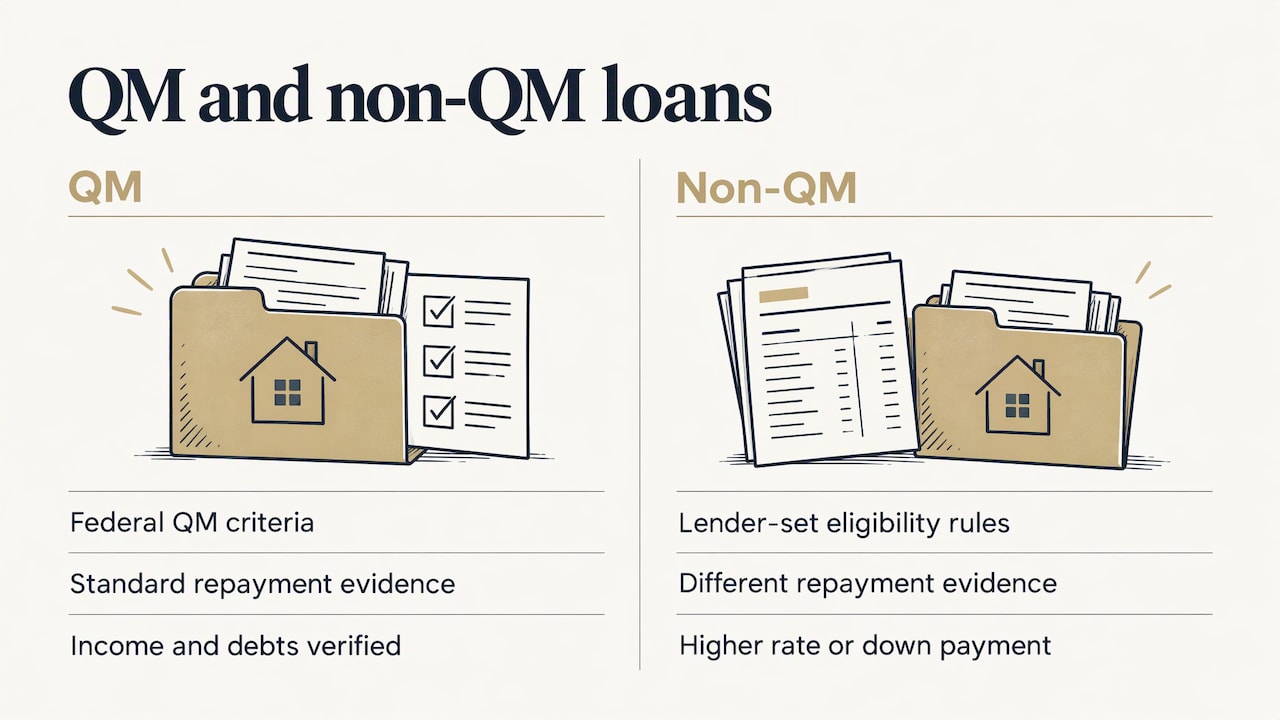
Federal rules generally require a lender to document and verify your income, employment, assets, debts and credit history to decide whether you can repay. A loan that meets certain criteria can be called a qualified mortgage (QM). A nonqualified mortgage is used when the loan has characteristics that make it ineligible for that label. The Consumer Financial Protection Bureau (CFPB) notes that such loans can be riskier or more expensive.
The qualified mortgage standard comes from the Dodd-Frank Act. According to Investopedia, non-QM loans follow their own criteria rather than those requirements. The lender sets the eligibility rules, and they often involve larger down payments, higher interest rates, or both.
Non-QM does not mean the lender skips the ability-to-repay question. It means the lender answers it with different evidence. A self-employed borrower who writes off many expenses may show low taxable income but strong monthly deposits. A non-QM program can read that file differently.
Who non-QM loans are designed for
NerdWallet describes these loans as built for borrowers whose finances do not fit a typical qualified mortgage. The usual reasons are:
- Inconsistent or nontraditional income
- A major credit event
- High debt levels
In South Florida, we most often see the following groups:
- Self-employed borrowers whose tax returns understate cash flow.
- Real estate investors buying rentals who want the property’s income to carry the loan.
- International buyers who earn and bank abroad and may have no U.S. credit history.
- High-net-worth buyers with large assets but irregular income.
- Borrowers rebuilding after a bankruptcy or foreclosure.
How non-QM underwriting differs
Income documentation
Instead of W-2s and two years of tax returns alone, lenders may accept tax returns, bank statements, asset qualifiers or 1099s, depending on the lender’s requirements. The right choice depends on how your income is earned and how you can best prove it.
Debt-to-income ratio
Qualified mortgages have a maximum debt-to-income ratio of 43% according to NerdWallet, while some non-QM loans allow ratios above 50%. That gap matters for borrowers with significant obligations but strong reserves.
Credit events
Timelines after a bankruptcy or foreclosure are shorter in some programs. NerdWallet reports that some lenders allow a non-QM mortgage as soon as one day after a bankruptcy or foreclosure. Each lender sets its own rules, so the practical answer depends on your file and the program.
Non-QM loan types
Non-QM is an umbrella. The program you choose should follow the way you earn money.
| Program | Who it fits | How income or ability to repay is shown |
|---|---|---|
| Bank statement loan | Self-employed borrowers, business owners, freelancers | Deposits in personal or business bank statements |
| Profit and loss loan | Self-employed borrowers with a current business picture | A profit and loss statement |
| DSCR loan | Investors buying rental property | The property’s rental income against its debt payments |
| Asset depletion loan | Buyers with large liquid assets and limited regular income | Verified assets |
| Foreign national loan | International buyers without U.S. credit or income history | Alternative documentation for income, assets and identity |
| Mixed-use loan | Buyers of properties with residential and commercial space | Property and borrower profile |
Some of these also come in non-QM structures with interest-only periods or adjustable rates. Those features are covered in the next section.
Non-QM, non-conforming and conforming: sorting the terms
People search for “non-conforming” and “non-qualified” as if they were one thing. They are related but not the same.
- Conforming means a loan fits the guidelines and size limits that let it be sold to the government-sponsored enterprises, Fannie Mae and Freddie Mac.
- Non-conforming is the broad label for anything outside those guidelines. A jumbo loan above the conforming limit is one example.
- Non-QM is about the ability-to-repay standard rather than loan size. Per Janus Henderson, loans that do not meet agency underwriting guidelines are called non-QM loans, and they are part of the non-agency mortgage-backed securities market, which carries no government guarantee.
A loan can be non-conforming without being non-QM. If your only issue is price, a jumbo loan may be the right fit. If the issue is how your income is documented or your credit history, you are in non-QM territory.
What non-QM loans cost
The trade-off is price. NerdWallet says non-QM loans may require a larger down payment and typically carry a higher interest rate than qualified mortgages. Investopedia says the same about the usual terms.
Three practical points follow:
- Rates vary by program and borrower. Credit score, down payment, reserves and property type all move the price. Compare your own quotes rather than relying on averages.
- Compare the full cost, not only the rate. Look at points, lender fees and any prepayment terms on the Loan Estimate.
- A higher rate can be temporary. Many borrowers use a non-QM loan for a period and later refinance once their documents fit a standard program. Whether that works depends on future rates and your file.
To see how a rate and down payment change your payment, use the mortgage calculator. Our daily rate page shows current trends.
Safe use: features to check before you sign
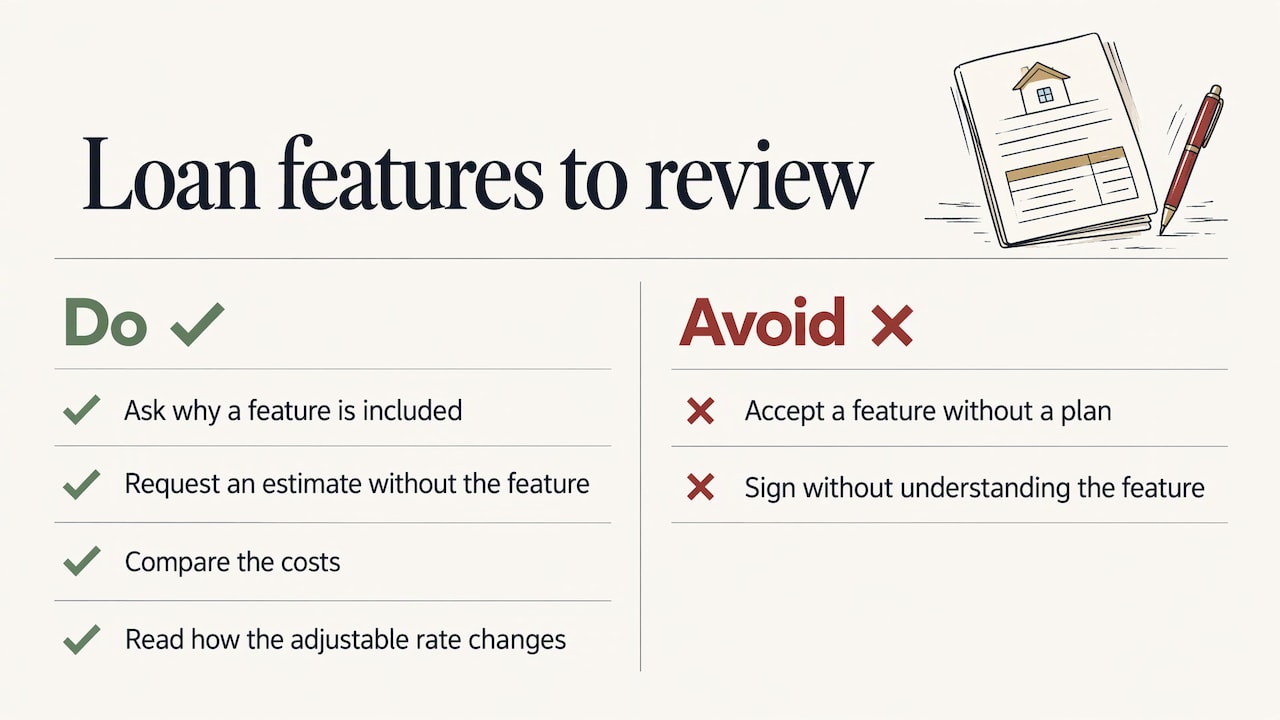
The CFPB advises borrowers to look for prepayment penalties, balloon payments, negative amortization and interest-only payments. If your Loan Estimate includes one, ask why. Then request another Loan Estimate without the feature and compare the costs.
Some features are reasonable for the right plan. An investor who will sell in three years may accept a structure that a long-term homeowner would not. What matters is that the feature is there on purpose and you understand it. If the loan has an adjustable rate, read how the rate adjusts. We explain that on our adjustable-rate mortgage page.
A broker or a bank for a non-QM loan
UF/IFAS Extension’s Florida homebuyer curriculum advises borrowers to compare multiple mortgage sources, including banks and independent mortgage brokers, and to consider several lenders rather than relying on one.
That advice fits non-QM especially well. Each non-QM lender writes its own guidelines, so the same borrower can be approved by one and declined by another. A single bank offers its own programs. A broker works with a range of lenders and can place your file with the one whose rules match your situation. This is the reason many self-employed and international borrowers in South Florida work with a broker.
Perspective
Most of the borrowers who call us about non-QM are not weak borrowers. They are business owners, investors and international buyers whose finances are simply documented differently. The question we start with is not whether you fit one rigid box, but which lender’s guidelines fit your file.
We work with a broad range of lenders, so we can compare programs for your income type, property and timeline in one conversation. For a self-employed buyer that may be bank statements. For an investor it may be a DSCR structure. For a foreign national it may be a program built for buyers without U.S. credit history.
Our approach is to explain the trade-offs plainly: the rate, the down payment, the terms, and the plan for what comes next. A well-matched non-QM loan is a tool that gets a qualified person into a property, and we like to see the file organized before the offer is requested.
Julia Zhguleva
How to prepare your application
A clean file speeds up approval and improves the terms you are offered. Follow these steps:
- Choose the income method. Decide with your loan officer whether bank statements, a profit and loss statement, assets or rental income show your finances best.
- Gather documents. Typical items include identification, bank statements, business records and proof of funds for the down payment and reserves. Your program will list exactly what it needs.
- Review credit. Know your score and any recent events before you apply.
- Define the plan. Will you hold the property long term, rent it or sell? That decides which loan structure makes sense.
- Compare Loan Estimates. Use the same loan amount and down payment across offers.
Our loan process page walks through each stage from application to closing.
Talk to us about your non-QM options
Mortgage by Julia Zhguleva serves homebuyers, homeowners and investors in Aventura and throughout Florida. Julia has more than 20 years in banking and finance, and the business reports over $350 million in closed loans. We offer bank statement, foreign national and DSCR loans, as well as investment property financing, jumbo loans and refinance programs, with lender matching built around your situation.

To see the full list of programs, visit our loan programs page, or start from our home page to talk through your scenario.
FAQ
Is a non-QM loan the same as a non-conforming loan?
No. Non-conforming describes loans that fall outside agency guidelines, for example a jumbo loan above the conforming limit. Non-QM describes loans that do not meet the qualified mortgage standard. The two overlap, but a loan can be one without the other.
Can I get a non-QM mortgage if I am self-employed?
Yes, this is one of the most common uses. Lenders may accept bank statements, 1099s or tax returns depending on the program. Our bank statement loan page explains the documents in more detail.
Are non-QM rates higher than conventional rates?
Typically, yes. NerdWallet notes these loans usually carry higher interest rates and may need a larger down payment. The exact difference depends on the lender, program and your profile, so compare current quotes.
Can a foreign national buy a Florida home with a non-QM loan?
Yes, foreign national programs exist for buyers without U.S. credit or income history, and requirements differ by lender. We can match your documents to a suitable program. See our loan programs for the options.
Sources
- What Are Non-QM Loans? – NerdWallet
- Understand the different kinds of loans available – CFPB
- Non-Qualified Mortgages: What They Are, How They Work – Investopedia
- Non-Agency Residential Mortgage-Backed Securities – Janus Henderson
- My Florida Home, Finding a Mortgage – UF/IFAS Extension