
A cash-out refinance on a rental property replaces your current investment mortgage with a larger one and pays you the difference in cash. You can use that cash for another down payment, repairs, reserves or paying off other debt. The loan has to fit a lender’s rules for investment properties, which are stricter than the rules for a primary home. As a mortgage broker, we compare lenders and match each file to the one that fits the borrower’s income, credit and goals and can close the loan. That matters most on rental files, where the right program depends on how the property earns and how you hold title.
TL;DR
- A rental cash-out refinance pays off your existing mortgage and gives you the leftover equity as cash. Lenders cap the new loan at a percentage of the property’s value, and the cap is lower for investment properties than for a primary residence.
- Under Fannie Mae’s guide, the loan being paid off must generally be at least 12 months old, and at least one borrower must have been on title for at least six months, with listed exceptions.
- Income can be qualified by tax returns and lease income, or, on some loans, by the property’s own rent through a DSCR loan. Short-term rentals have their own documentation rules.
- The interest is only deductible as a rental expense to the extent the money is used for the rental. Talk to a CPA before you spend the proceeds.
- We do not quote rates or payments in articles. Request a free quote to see what your file qualifies for.
Table of Contents
- What a cash-out refinance on a rental property does
- How much cash you can take out
- Cost: what moves the price
- Eligibility rules for investment property cash-out
- How lenders count your rental income
- Short-term rentals and Airbnb-style properties
- Step by step: applying for a rental cash-out refinance
- Taxes: when the interest is deductible
- Is a cash-out refinance the right tool?
- Our perspective
- Talk through your rental refinance with us
- FAQ
- Sources
What a cash-out refinance on a rental property does
You own a rental worth a certain amount and owe less than that. The difference is your equity. In a cash-out refinance, a new first mortgage pays off the old one, and the extra loan amount is paid to you at closing.
Fannie Mae’s Selling Guide lists the acceptable uses of cash-out proceeds: paying off the existing first mortgage, covering closing costs and prepaid items, paying off other liens, and taking equity out for any purpose. For an investor, the common purposes are:
- The down payment on the next rental
- Renovations that raise rent or value
- Cash reserves, which lenders look for on investment files
- Consolidating other debt secured by the property
A cash-out refinance is different from a rate-and-term refinance, which changes the rate or term without taking equity out. If you are weighing the two, our guide to cash-out vs. rate-and-term refinance walks through the difference.
How much cash you can take out
The cash you can access depends on loan-to-value (LTV), which is the new loan divided by the property’s appraised value. Fannie Mae’s Eligibility Matrix sets maximum LTVs by occupancy and unit count. For an investment property cash-out refinance, it lists 75% for a one-unit property and 70% for a two- to four-unit property. Individual lenders can set stricter limits, and non-agency programs have their own.
Here is a simple worked example. The numbers are for illustration only and are not a quote:
- Your Florida rental appraises at $500,000.
- At a 75% maximum LTV, the new loan could be up to $375,000.
- You owe $250,000 on the current mortgage.
- After paying that off, the remaining room is $125,000, before closing costs and any other liens are paid.
The appraisal drives the whole calculation. A lower value means less cash, and the cash is also reduced by closing costs. This is one reason to review the numbers with a broker before you order anything.

Cost: what moves the price
We do not publish rates, APRs, payments or fees in articles, because they change daily and depend on the file. It helps to know what moves the price on an investment cash-out loan:
- Credit score. Fannie Mae’s loan-level price adjustment matrix, updated September 30, 2026, lists cash-out adjustments by credit score and LTV band. Higher scores and lower LTVs generally price better.
- LTV. The more equity you leave in the property, the less risk the lender takes.
- Property type. One-unit, two- to four-unit and condo properties are priced and limited differently.
- Loan program. Agency loans, DSCR loans and other non-agency loans follow different pricing.
Fannie Mae’s matrix also notes that it removed the reference to a 620 minimum credit score for loans submitted to its underwriting system on November 17, 2025, and that VantageScore 4.0 use was expanded to all lenders on September 9, 2026. Your lender’s own credit overlays still apply, so the score a given lender will accept can differ from the agency floor.
For current pricing on your file, request a free quote from us rather than relying on a number in an article.
Eligibility rules for investment property cash-out
The rules below come from Fannie Mae’s guide. Many conventional lenders follow them, and other loan types use their own versions.
Seasoning on the loan and on title
Fannie Mae requires that the first mortgage being paid off be at least 12 months old, measured from note date to note date. At least one borrower must also have been on title for at least six months before the loan is disbursed. The guide lists exceptions, including inheritance, a divorce award, delayed financing, and property held in an LLC or revocable trust. Details are in Fannie Mae’s cash-out refinance rules.
Reserves and debt-to-income
Debt-to-income (DTI) is your monthly debt payments divided by your monthly income. Fannie Mae’s guide says that on loans run through its underwriting system, a DTI above 45% requires six months of reserves on a cash-out refinance. Reserves are liquid funds you keep after closing, expressed as months of the property’s payment. Rental files often need more reserves than a primary-home loan, so the amount is worth checking early.
The property cannot be listed for sale
The same guide requires a property listed for sale to be taken off the market on or before the disbursement date. Lenders do not want a cash-out loan to be a bridge to a sale.
Credit score
Minimum scores vary by lender and program. Because pricing improves as scores rise, a few weeks spent paying down revolving balances before you apply can change the outcome. We can look at your credit and tell you which programs are realistic.
Holding the property in an LLC
Many Florida investors hold rentals in an LLC. Agency loans are written to individuals, and the guide lists LLC-held property as a seasoning exception, but whether and how a lender will lend against LLC-held property varies. Lenders that do loans to entities are often non-agency lenders. Settle the title question with your attorney and your loan officer before you apply, not after.
How lenders count your rental income
There are two broad ways to qualify, and choosing the right one is often the difference between a clean approval and a decline.
Personal income and tax returns
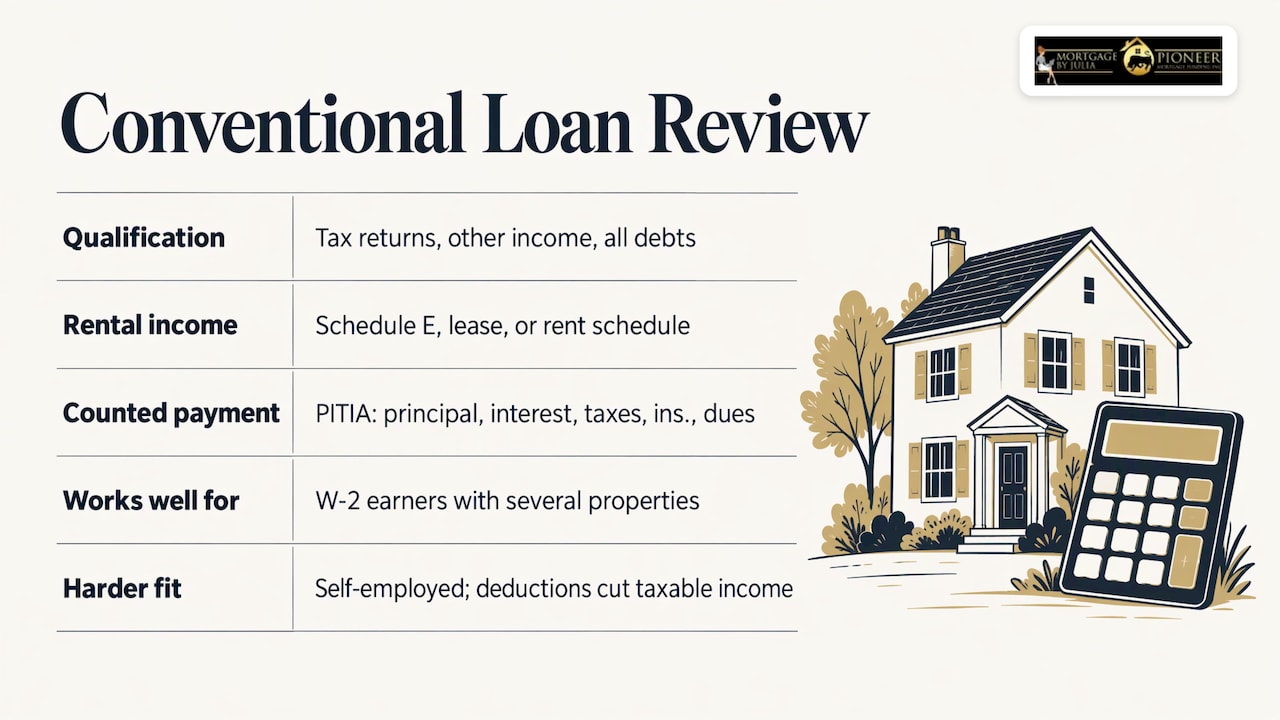
On a conventional loan, the lender looks at your tax returns, your other income and all your debts. Rental income from the property is usually taken from your Schedule E (the part of your federal return that reports rental income and expenses) or from a lease and appraiser’s rent schedule, then offset by the property’s payments. The payment the lender counts is called PITIA: principal, interest, taxes, insurance and association dues. Your landlord policy is part of that figure, so it helps to know what rental property insurance coverage costs for your property before you run the numbers.
This route can work well for W-2 earners with several properties. It can be harder for self-employed investors whose deductions reduce taxable income, or for investors who already hold many financed properties.
The property’s own income: DSCR
A DSCR (debt service coverage ratio) loan qualifies the property by comparing its rent to its mortgage payment, rather than relying mainly on your personal tax returns. If you are self-employed, hold many properties or write off a lot of expenses, this can be a better fit. We explain how it works on our DSCR loans page.
Other ways to qualify
Some borrowers qualify better on bank statements or on assets than on tax returns. Our asset depletion loans page covers qualifying from liquid assets. A broker can lay out these options side by side, which one lender working from one rulebook cannot.
Short-term rentals and Airbnb-style properties
If you rent by the night or week, the loan underwriting changes. Fannie Mae’s guide on short-term rental income, updated September 2, 2026, defines a short-term rental as a furnished residential property rented for periods typically under 30 consecutive days. Its main rules:
- STR income can be used only for a one-unit investment property that is legally permitted to operate as an STR under local registration and licensing rules.
- The income cannot be derived from an accessory dwelling unit.
- On a purchase, the lender documents rent with an appraiser’s rent form or with validated data from three comparable STRs, multiplies monthly gross rent by 50%, and subtracts PITIA.
- On a refinance, the lender uses a Schedule E cash-flow analysis, or the same 50% method if the property is not yet on your tax return.
The 50% factor is why a short-term rental with strong gross bookings can still show less qualifying income than you expected. It allows for vacancy and operating costs.
In Florida, the legal permission piece matters. Rules on short-term rentals differ by city, county and condo association. Many condo buildings restrict or ban rentals under 30 days or even under a year, so confirm your association’s documents before you plan a refinance around nightly rental income. If the property is a condo, our free condo approval review looks at the building itself, and our condotel loans and non-warrantable condo loans pages cover buildings that standard lenders pass on.
Step by step: applying for a rental cash-out refinance
- Estimate your equity and target LTV. Use a realistic value, then apply the LTV cap for your property type. Subtract the current payoff and your closing costs. If the cash left over does not cover your goal, the refinance may not be the right tool.
- Check seasoning. Confirm your current mortgage is at least 12 months old and how long you have been on title, and see whether an exception applies.
- Pull your documents. Expect to provide recent tax returns, income documents, current lease agreements, the current mortgage statement, the insurance declaration page, property tax information and asset statements. Lenders tell you the exact list for your program.
- Choose the qualifying method. Decide between personal income, DSCR or another non-agency approach based on how your income looks on paper.
- Compare lenders. The same property can price very differently between lenders, and some will not lend on certain property types at all. Our cash-out refinance page explains how we approach this.
- Order the appraisal and move through underwriting. The appraisal sets the loan amount. Respond to underwriter conditions promptly.
- Close and plan the cash. Funds are delivered after closing. Have a plan for them, and a tax plan, before you sign.
No broker or lender can promise approval, a rate, terms or a closing date. What a broker can do is show you early which version of the loan is likely to work.
Taxes: when the interest is deductible
This part is easy to get wrong, so talk to a CPA or tax professional before you close. The IRS explains in Publication 527 that you can deduct mortgage interest on a rental property, but when you refinance for more than the previous balance, the interest on the portion not related to rental use generally cannot be deducted as a rental expense.
The underlying rule is that interest follows how the money is used. The Treasury regulation on allocating debt and interest expense says debt proceeds and the related interest are allocated by reference to the use of the proceeds. In practice:
- Cash used to renovate the rental is tied to the rental.
- Cash used to buy another rental is tied to that rental.
- Cash used for personal spending is not a rental expense.
Keep the cash in a separate account and document where it goes. That record is what your tax preparer will need.
Is a cash-out refinance the right tool?
It is one of several ways to turn equity into cash. If you want to keep your current low rate on the first mortgage and only need a smaller amount, a HELOC can sit behind it. If the property is a larger building, a multifamily loan or a commercial refinance may be the better category. If you plan to buy and renovate your next property, a fix and flip loan is built for that. Which one fits depends on your current rate, the amount you need and how soon you need it.
Our perspective
Most investors come to us asking for the cash-out amount. The first question we ask is different: how will this property and this borrower look on paper to an underwriter?
A cash-out refinance on a rental property is a file-building exercise. Seasoning, title, reserves, how the income is documented and whether the building allows the rental use you are planning all decide the result before a rate is ever discussed. Fixing a problem before the application is far easier than discovering it in underwriting.
That is the reason we work as a broker. We have been in banking and finance since 2006 and have closed $350M+ in loans for 2,000+ clients. We are known for complex files: investors, self-employed borrowers, foreign nationals, and transactions with cryptocurrency or foreign assets. Instead of fitting you into one bank’s product, we compare lenders and look for the one that matches your income, credit and goals and can close the loan.
Bring us the property, the title structure and your plan for the cash. We will tell you plainly what is likely to work, and what to change if it is not.
Julia Zhguleva
Talk through your rental refinance with us
Mortgage By Julia is the brokerage of Julia Zhguleva, Branch Manager and mortgage loan originator at Pioneer Mortgage Funding (PMF, Inc., NMLS #1980), Individual NMLS #684117, licensed in Florida and Michigan. We help investors in Aventura and throughout Florida with investment property financing and cash-out refinancing, in English and Russian. United Wholesale Mortgage recognized Julia as a top 1% mortgage producer in Florida for four consecutive years, 2022-2025.

To see where your property stands, start with a free quote on our website. Tell us the property type, the current loan and what the cash is for.
FAQ
Can I do a cash-out refinance on a rental property?
Yes, lenders offer it, with lower maximum LTVs and more documentation than on a primary home. Under Fannie Mae’s guidelines, the maximum LTV for a one-unit investment property cash-out refinance is 75%, and 70% for two to four units. Other programs set their own limits.
How long do I have to own a rental before I can cash-out refinance?
Fannie Mae’s guide requires at least one borrower to have been on title for at least six months, and the loan being paid off to be at least 12 months old, with exceptions such as inheritance, delayed financing, and LLC or trust-held property. Other lenders and loan programs may set different waiting periods.
Can I use short-term rental income to qualify?
Often yes, but with conditions. Under Fannie Mae’s rules, STR income is limited to one-unit investment properties that are legally permitted to operate as STRs. A purchase uses 50% of documented gross rent minus PITIA, and a refinance uses your Schedule E or the same method if the property is not on your return yet.
Is the interest on a rental cash-out refinance tax deductible?
Only the part tied to rental use is generally deductible as a rental expense. The IRS says the interest on refinanced proceeds not related to the rental generally cannot be deducted as a rental expense. Ask your CPA how your specific use of the cash is treated.
Is a DSCR loan better than a conventional cash-out refinance?
It depends on your income. A DSCR loan qualifies mainly on the property’s rent compared with its payment, which can suit self-employed investors and those with many properties. A conventional loan can fit borrowers whose tax returns show strong income. We can review both against your file.
Sources
- Fannie Mae Selling Guide: Cash-Out Refinance Transactions
- Fannie Mae Selling Guide: Rental Income from the Subject Property, Short-Term Rental
- Fannie Mae Eligibility Matrix
- Fannie Mae LLPA Matrix, updated 09-30-26
- IRS Publication 527, Residential Rental Property
- 26 CFR 1.163-8T, Allocation of interest expense
Recommended
- Cash-Out Refinance in South Florida
- HELOC in Florida: Home Equity Line of Credit
- Cash-Out vs. Rate-and-Term Refinance
- Investment Property Financing in Florida
This article is for general information only and is not a commitment to lend. Loan programs, rates and terms are subject to change and depend on borrower qualification. Equal Housing Opportunity | Julia Zhguleva, Individual NMLS #684117 | Licensed in FL & MI | Authorized to represent PMF, Inc. | NMLS #1980