
A commercial refinance replaces your existing commercial mortgage with a new loan, usually to pay off a maturing balance, lower the payment, change the loan terms or pull out equity. Most lenders look at three things: the property’s income, its value against the loan, and your financial strength as a borrower. Plan on roughly 45 to 90 days from application to closing, plus closing costs of about 1% to 3% of the loan.
This guide covers when a refinance makes sense, what lenders underwrite, the documents to gather, the costs, the timeline and how cash-out works. It is written for owners of apartment buildings, retail, office, industrial, mixed-use and other income property, including owners in Florida.
TL;DR
- Commercial loans often amortize over 25 to 30 years but mature in 5 to 10 years, so a refinance is how most owners pay off the balloon at maturity.
- Lenders typically test loan-to-value (LTV), debt service coverage ratio (DSCR) and debt yield. Expect a DSCR minimum around 1.20x to 1.35x.
- Budget about 1% to 3% of the loan for closing costs, and check your current loan for a prepayment penalty before you start.
- Allow 45 to 90 days, and start well before your maturity date.
- A broker who works with many lenders can help you compare structures rather than accept one bank’s terms.
Table of Contents
- How a commercial refinance works
- When refinancing a commercial property makes sense
- What lenders look at
- What a commercial refinance costs
- Documents to gather before you apply
- The process, step by step
- Cash-out refinance on commercial property
- Choosing the right structure by property type
- Our perspective
- Talk to us about your commercial refinance
- FAQ
- Sources
How a commercial refinance works
A commercial mortgage is not like a 30-year home loan. Many are amortized over 25 to 30 years but come due in 5 to 10 years, which leaves a large balloon payment at maturity. You either pay that balance from savings, sell the property, or refinance it with a new loan. That is why a commercial refinance is a routine part of owning income property, not only a way to chase a better rate.
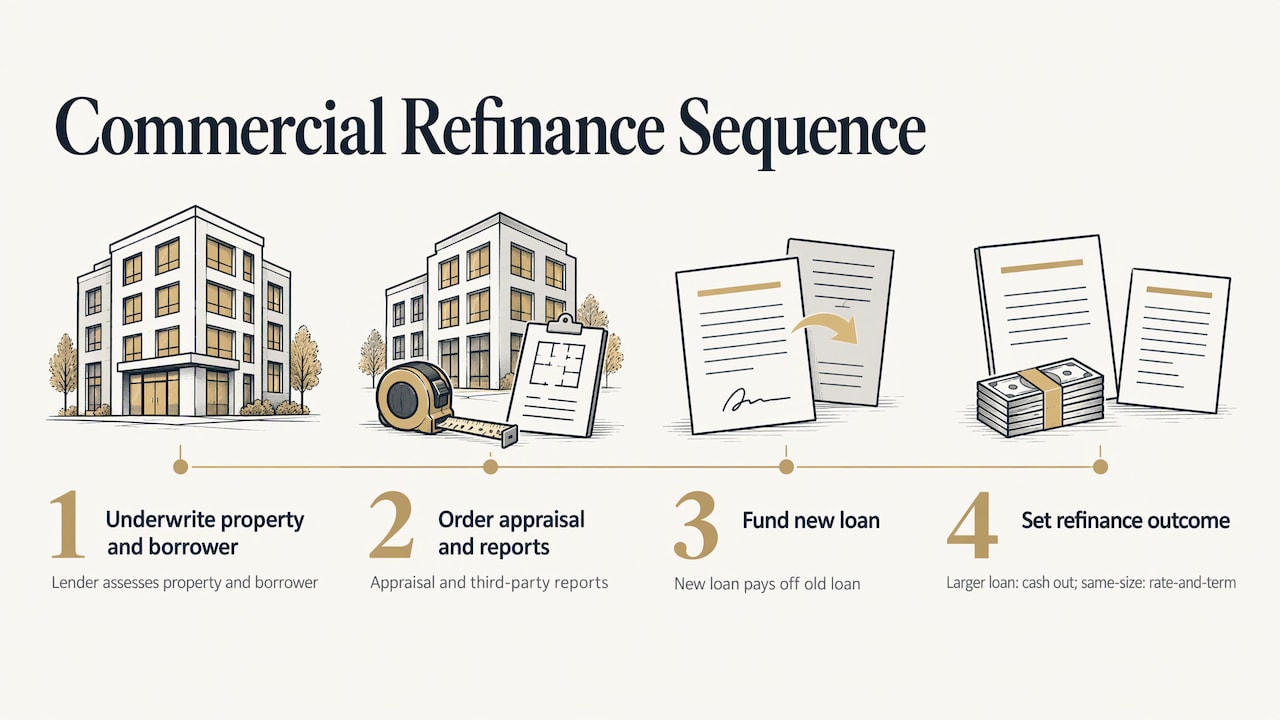
The mechanics are simple. A new lender underwrites the property and the borrower, orders an appraisal and other third-party reports, and funds a new loan that pays off the old one. If the new loan is larger than the payoff, the difference can come to you as cash. If it is the same size, you have a rate-and-term refinance, which changes the interest rate, the amortization or the term without extracting equity.
Residential refinancing differs in one important way. Commercial lenders underwrite the building first and the borrower second. A property with strong, stable rent can qualify even when an owner’s personal income is complicated, which matters for investors holding property through an LLC.
When refinancing a commercial property makes sense
There is no single right moment, but a few situations come up again and again.
- Your loan is approaching maturity. Start 6 to 9 months ahead. A refinance started in the last 60 days leaves no room for a surprise in the appraisal or the environmental report.
- Rates or spreads have moved in your favor. Compare the savings in annual debt service against total refinance costs and any prepayment penalty. A lower rate that costs more than it saves within your holding period is not a win.
- Your property performs better than when you bought it. Higher occupancy, renewed leases and rising net operating income (NOI) can qualify you for a higher loan amount or better terms than your original financing.
- You are leaving a short-term loan. Bridge or transitional loans are designed to be replaced by long-term financing once the property is stabilized.
- You want to change the structure. That might mean a longer amortization, interest-only years, a fixed rate in place of a floating one, or a different recourse structure.
- You need capital. Equity can fund renovations, a down payment on the next acquisition, or paying off higher-cost debt.
Check the prepayment terms first
Many commercial loans carry a prepayment penalty. Common structures include a step-down schedule (for example, a percentage that falls each year), yield maintenance, which compensates the lender for lost interest, and defeasance, in which you replace the loan’s collateral with securities. Yield maintenance and defeasance tend to cost more when market rates have fallen since you borrowed. Read the prepayment clause in your note before you request quotes, and ask your lender for a payoff figure for your intended closing date. Closing costs are quoted before any prepayment penalty on the existing debt, so add that line yourself.
What lenders look at
Underwriting a commercial refinance comes down to a few ratios. Knowing them lets you estimate your options before you apply.
| Measure | What it tells the lender | Typical benchmark |
|---|---|---|
| Loan-to-value (LTV) | Loan amount divided by appraised value | 65% to 75% for conventional commercial loans, up to 80% for agency multifamily, up to 90% for SBA 504 on qualifying owner-occupied property |
| Debt service coverage ratio (DSCR) | NOI divided by annual loan payments | Generally 1.20x to 1.35x |
| Debt yield | NOI divided by loan amount | Often 8% to 10% minimum |
| Occupancy and lease quality | How reliable the income is | Stable occupancy, with lease terms that extend past the new loan’s early years |
Other sources describe the typical expectation as a DSCR of at least 1.25 and LTV at or below 80%. The exact numbers vary by lender, property type and market, so treat these as ranges.
A worked example
Say your building produces $300,000 of NOI and is appraised at $4,000,000. A lender with a 70% LTV cap and a 1.25x DSCR minimum would test the loan two ways.
- LTV limit: 70% of $4,000,000 is $2,800,000.
- DSCR limit: $300,000 divided by 1.25 is $240,000 of annual debt service the property can support. At a payment that works out to, say, 7.5% on a 25-year amortization, that supports a loan of roughly $2.6 million.
The lower of the two controls. In this example income, not value, is the constraint, which is why raising NOI before you apply (renewing leases, filling vacancies, correcting expense overages) often does more than waiting for a higher appraisal. The interest rate in this example is an illustration, not a quote.
Bank regulation sits behind the process
Banks that lend on commercial real estate follow supervisory guidance. The Office of the Comptroller of the Currency publishes a Comptroller’s Handbook on commercial real estate lending for examiners of national banks, federal savings associations and federal branches of foreign banks. You do not need to read it to refinance, but it explains why lenders insist on appraisals, documented repayment capacity and stress testing.
What a commercial refinance costs
Budget for total closing costs of roughly 1% to 3% of the loan amount. The main line items include:
- Lender origination fee: often 0.5% to 1% of the loan; another source puts the range at 0.5% to 2%.
- Appraisal: $3,000 to $10,000 or more, depending on the property. Federal rules call for a certified appraisal by a state-licensed appraiser on commercial transactions above $500,000.
- Phase I environmental site assessment: commonly $2,000 to $4,000, though pricing climbs with property size and risk.
- Property condition report, legal fees, title insurance and survey. Legal fees for document preparation can run $3,000 to $10,000.
- Prepayment penalty on the old loan, if any, as described above.
On a $2,500,000 loan, 1% to 3% is $25,000 to $75,000. Ask every lender for a written estimate of third-party costs and which are refundable if the deal does not close. For a plain-language look at how closing costs are built on the residential side, see our guide to mortgage closing costs in Florida.
Documents to gather before you apply
A complete package shortens underwriting. Organize these items first:
- Two to three years of property operating statements and tax returns.
- A current rent roll and copies of all leases.
- Year-to-date financials and a trailing-12-month income statement.
- Personal financial statements for guarantors, and for every individual holding 20% or more ownership.
- Entity documents for the borrowing LLC or partnership, and its tax returns.
- Tenant estoppel certificates, a land title survey and a zoning compliance report, which lenders commonly ask for on larger loans.
- Existing loan documents, including the note and the prepayment clause.
The habit of assembling paperwork early is the same one that speeds up a home loan, and our mortgage document checklist shows how to organize the personal side of it.
The process, step by step
- Define the goal. Lower payment, longer term, cash-out or paying off a balloon. The goal changes which lenders fit.
- Prepare the financial package. Clean numbers matter more than speed. Fix obvious errors in the rent roll before a lender finds them.
- Estimate your proceeds. Use the LTV, DSCR and debt-yield tests above to find the likely maximum loan.
- Compare several lenders. Banks, credit unions, life companies, agency lenders and debt funds price the same asset differently. Compare rate, amortization, prepayment terms, recourse and fees together, not rate alone.
- Underwriting and approval. The lender orders the appraisal, environmental report and property condition assessment, and verifies income and leases.
- Closing. You lock the rate, sign final documents, complete title work and receive funding.
The whole sequence usually takes 45 to 90 days from application to closing, depending on the loan type and how complete your package is.
Cash-out refinance on commercial property
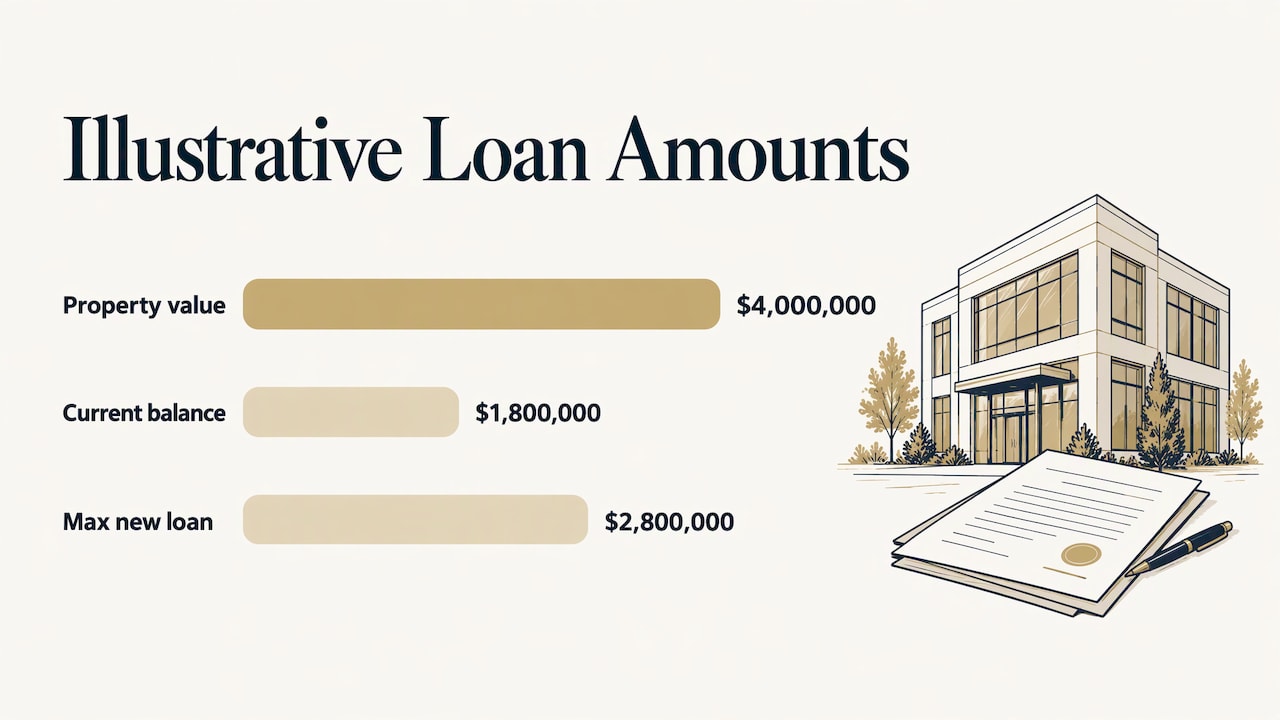
A commercial cash-out refinance lets you borrow more than you owe and keep the difference. The maximum depends on the lower of the LTV and DSCR limits shown earlier. Because lenders typically cap conventional LTV at 65% to 75%, a cash-out loan on a property worth $4,000,000 with a $1,800,000 balance could produce a new loan of up to $2,800,000 at 70%, but only if income supports the payment. After closing costs and the payoff, the net amount you receive is smaller than the headline increase.
Be prepared to explain how you will use the money. Lenders generally respond best to purposeful uses: improving the property, buying another asset, retiring higher-cost debt or funding tenant improvements that raise income. Owner-occupied properties can sometimes use SBA 504 financing, which can reach higher leverage, with eligibility rules set by the SBA, so confirm requirements on the SBA’s official site or with a lender who offers it.
Cash-out on a smaller investment property can sometimes be structured through an investor program instead of a conventional commercial loan. Our pages on DSCR loans and investment property financing explain how income-based qualification works for investors.
Choosing the right structure by property type
Different assets suit different loans.
- Multifamily: agency and bank programs can offer higher leverage. See our overview of multifamily loans in Florida.
- Mixed-use: apartments above retail are underwritten on both income streams. Details are on our mixed-use loans page.
- Retail, office, industrial and other commercial property: underwriting centers on lease quality, tenant credit and remaining lease term.
- Owner-occupied buildings: lenders look at your business’s own financials as well as the property.
When income is lumpy or the building is in transition, a lender may want to see stabilization first. A broker experienced with commercial deals can improve execution, especially for borrowers without existing lender relationships or for transitional assets.
Our perspective
Owners tend to start a commercial refinance by asking what rate they can get. We start with the question of which structure fits the property and the plan for it. A slightly higher rate with a longer amortization, a prepayment schedule that matches how long you intend to hold, or a loan size that leaves room for a future sale can be worth more than the lowest quote on a single page.
That is the reason we work with a broad range of lenders instead of one balance sheet. Our approach is to review your property’s income, your timeline and your goals, then match the loan to programs that suit that picture. Julia Zhguleva brings more than 20 years in banking and finance to that work, and the team has closed over $350 million in loans.
We also see how often a refinance goes smoothly when the owner prepares early: a clean rent roll, a clear explanation of how proceeds will be used, and a realistic view of timing. Our commercial loan options are built around that kind of preparation, with clear communication from first call to closing.
Julia Zhguleva
Talk to us about your commercial refinance
If you own commercial or income property in Florida and want to compare refinance options, we can review your numbers and outline the loan structures that may fit. Our commercial loans page explains the programs we arrange, and our refinance programs page covers rate-and-term and cash-out options.

To get started, contact Mortgage by Julia with your property type, current loan balance and maturity date.
FAQ
Can I refinance a commercial property before the loan matures?
Yes, but check your note for a prepayment penalty first. Step-down schedules, yield maintenance and defeasance all affect the break-even point. Ask your lender for a payoff quote for your target closing date and compare it to the savings from the new loan.
What credit score do I need for a commercial refinance?
Commercial lenders focus mainly on the property’s income and value, so there is no single universal score. Guarantors still submit personal financial statements, and lenders review their liquidity and credit history. Requirements differ by lender and program, so ask for them in writing.
How long does a commercial refinance take?
Plan on 45 to 90 days from application to closing. Third-party reports such as the appraisal and environmental assessment are common causes of delay, so order or schedule them early and respond to lender requests quickly.
Is a commercial refinance different from refinancing a rental house?
Often, yes. One-to-four unit rentals can usually be financed with residential-style investor loans, including DSCR programs. Five or more units, mixed-use buildings and other commercial property are generally underwritten as commercial loans, with shorter terms and balloon payments.
How much can I take out in a cash-out refinance?
The limit is the lower of the maximum LTV and the loan your income can support at the lender’s minimum DSCR. Subtract your existing payoff and closing costs to estimate what you would actually receive.
Sources
- Everything You Need to Know about Refinancing Commercial Real Estate
- Commercial Mortgage Refinancing: Rates, Requirements and Costs
- How to Refinance a Commercial Loan: Requirements and Steps
- Commercial Real Estate Lending, Comptroller’s Handbook (OCC)
- SBA 504 loans