
A commercial bridge loan is short-term financing secured by commercial property. It covers a purchase, renovation or lease-up period until you can sell the property or replace the loan with permanent financing. The deal works when the exit is clear and the timeline is realistic. At Mortgage By Julia, we match commercial borrowers in Florida with lenders from a broad range of programs, so the loan fits the property and the plan.
TL;DR
- A commercial bridge loan, sometimes called a short-term commercial mortgage, funds a property while it moves toward a sale or a long-term refinance.
- Federal bank regulators describe bridge loans as giving a property up to about three years to stabilize through lease-up and income growth.
- Lenders underwrite the business plan and the exit, not only your credit: income and value assumptions must be well supported.
- Compare the whole cost: interest, origination points, reserves, extension terms and prepayment rules, not the rate alone.
- Florida investors can start with a scenario review on the commercial loans page.
Table of Contents
- What a commercial bridge loan is
- When a bridge loan makes sense
- How lenders underwrite a bridge loan
- What a bridge loan costs and what to compare
- A worked example
- The exit: plan A and plan B
- How much equity do you need?
- Bridge loan, permanent mortgage or mezzanine loan
- Perspective
- Getting your file ready
- Work with a Florida commercial broker
- FAQ
- Sources
What a commercial bridge loan is
A bridge loan does what the name says: it spans a gap. A property is not yet ready for a conventional long-term loan, because it is vacant, partly leased, under renovation or newly acquired. Short-term money carries it until the numbers improve.
The Office of the Comptroller of the Currency (OCC), the federal regulator of national banks, describes this directly in its Commercial Real Estate Lending handbook. Bridge loans give newly constructed or acquired properties time to reach stabilization, typically up to three years. Stabilization means the building has enough leases and steady income to qualify for permanent financing or to sell.
Three features separate a bridge loan from a standard commercial mortgage:
- Short term. You borrow for months or a few years, not 20 or 25.
- Exit-driven. The loan is repaid by a sale or a refinance, so the exit plan is part of the application.
- Transitional property. The asset often has something to fix, fill or finish.
The same financial regulators define commercial real estate lending broadly. In a 2015 interagency statement, the agencies describe it as financing to acquire, develop, construct, improve or refinance real property, repaid mainly from sales or third-party rent and lease payments. A bridge loan fits that definition, with a shorter clock.
When a bridge loan makes sense
Bridge financing is a tool for timing problems. These are the situations where it is most often used.
Buying before the property qualifies for permanent debt
A multi-tenant retail building with 40% vacancy may not meet a long-term lender’s income requirements. A bridge loan lets you close, sign tenants and then refinance once the rent roll supports it. Our pages on mixed-use loans and multifamily loans cover the property types where this comes up most in Florida.
Renovation or repositioning
If you are upgrading units, converting a use or finishing deferred repairs, the property’s current income understates its future value. Short-term financing funds the work, and the refinance happens after the improved income shows up on the books.

Closing fast
Auctions, estate sales and sellers who want a quick close do not wait for a long approval cycle. A short-term loan can match that pace when the file is organized in advance.
Replacing a maturing loan
A loan that is about to mature before you can refinance is a common trigger. The ABA Banking Journal notes that banks have established refinancing protocols and work with borrowers ahead of maturity dates. Starting the conversation early, well before the maturity date, gives you more options on both the bridge and the permanent loan.
How lenders underwrite a bridge loan
A permanent loan is mostly about the property’s current income. A bridge loan is about the path from where the property is to where it will be. Expect lenders to examine five things.
- The business plan. What are you changing, what will it cost, and how long will it take? The OCC says that income and value assumptions for bridge loans should be well supported and carefully analyzed. Bring leasing letters, contractor bids and comparable rents.
- The exit. Lenders want to see whether you will sell or refinance and why that will work. The same handbook says banking institutions are expected to set requirements for takeout commitments, the permanent financing meant to repay the loan.
- Loan size against value. Underwriting standards address maximum loan amounts, maturities and loan-to-value (LTV) limits that differ by property type. LTV is the loan divided by the property’s value. A lower LTV means you bring more equity.
- Your experience and liquidity. Lenders look at whether you have completed similar projects and whether you have cash to cover interest, repairs and surprises.
- The property itself. Location, condition, tenant mix, insurance, environmental findings and title all matter, and in Florida, wind and flood insurance cost can change the numbers noticeably.
Regulators expect lending institutions to maintain underwriting discipline and risk management for commercial real estate. For you, that means a thin file slows the process. A complete package shortens it.
What a bridge loan costs and what to compare
Bridge loans generally cost more than permanent loans, because the lender takes on the transition risk and the term is short. The exact pricing depends on the lender, the property and your plan, and we do not quote figures in an article, because they change with the market. Compare these items in every written quote.
| What to compare | Why it matters |
|---|---|
| Interest rate and whether it is fixed or floating | Floating rates change your carrying cost during the term |
| Origination fee (points) | One point is 1% of the loan amount, paid at closing |
| Interest-only payments or reserve | Many bridge structures pay interest only, so the balance is due at the end |
| Term and extension options | Know the cost and conditions to extend if a lease-up runs late |
| Prepayment terms | Matters if you sell or refinance sooner than planned |
| Recourse | Whether you are personally liable if the property does not cover the debt |
| Holdback for renovation funds | How and when construction money is released |
| Third-party costs | Appraisal, legal, title, environmental and insurance |
Work out the total cost over the full expected hold, including one extension. A lower rate with a high exit fee and strict extension conditions can cost more than a slightly higher rate with flexible terms.
A worked example
Here is an illustrative scenario with round numbers. It is a teaching example, not a quote.
An investor buys a small mixed-use building in Miami-Dade for $2,000,000. Half the commercial space is vacant. The business plan is to lease it up over 18 months. A bridge lender sets the loan at a percentage of the value, and the investor brings the rest as equity, plus a reserve to cover interest while the units are empty.
The plan works if three things happen: the leases are signed on schedule, the stabilized income supports a long-term loan, and the investor has enough reserves to absorb a delay. If the lease-up takes 24 months instead of 18, the extension terms decide whether the project survives. That is why the extension clause is a core item to compare, not fine print.
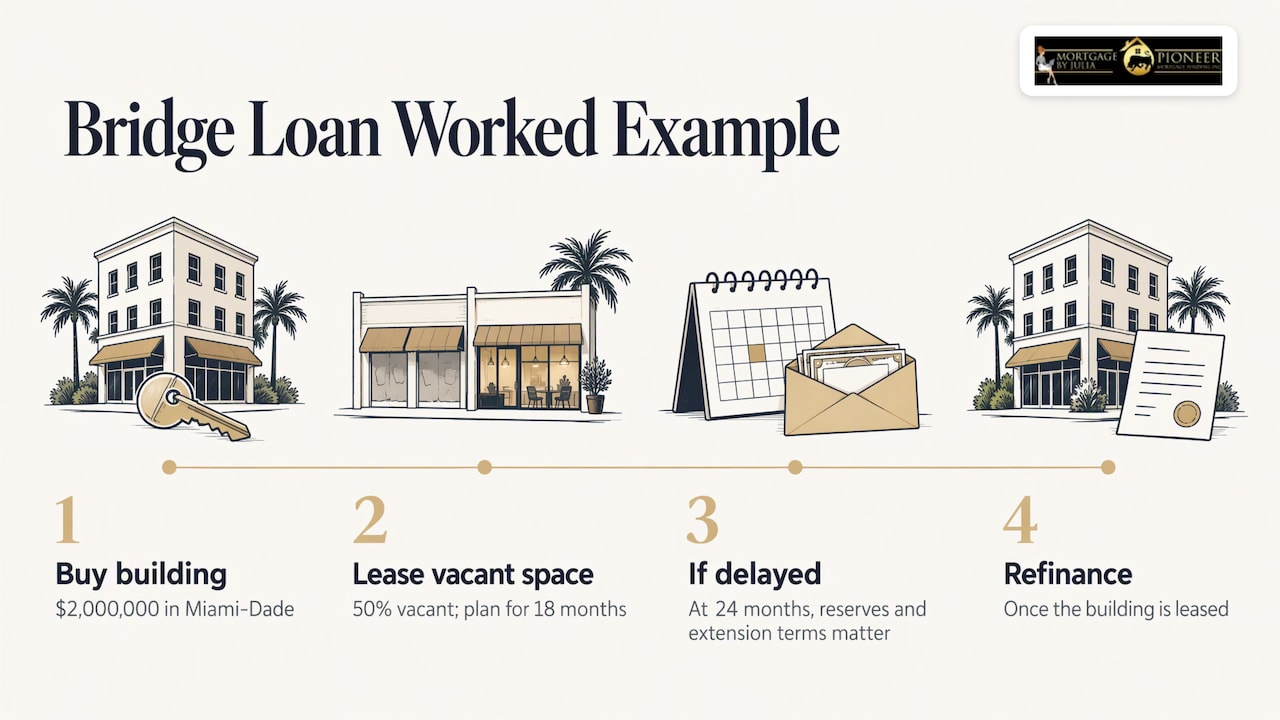
Once the building is leased, the investor refinances. Our guide to commercial refinance explains how that step works and what permanent lenders look for.

The exit: plan A and plan B
The biggest risk in a bridge loan is a missed exit. Plan it as carefully as the purchase.
- Refinance exit. Confirm what DSCR, the debt service coverage ratio (annual net operating income divided by annual loan payments), the permanent lender will require, and check that your stabilized income clears it with room to spare. For rental properties, DSCR loans are one long-term option because they qualify the property by its income.
- Sale exit. Estimate the sale price conservatively and allow time for marketing and closing.
- Plan B. Know in advance what you will do if rates are higher or values lower when the loan matures. Regulators have said that modified loans to borrowers who can repay should not be classified adversely solely because collateral value fell below the balance, which shows that lenders can work with borrowers in good faith, but it is not a substitute for a plan.
The ABA reported in September 2025 that lending standards for commercial real estate loans have moderated broadly, and that refinancing is a significant driver of loan demand. Market conditions shift, so ask for current terms when you are ready to move.
How much equity do you need?
There is no single answer. The amount of equity depends on the property type, its condition, the lender and the strength of your plan. Lenders set loan-to-value limits by property type, and a stabilized, well-located asset usually supports more leverage than a vacant or heavily distressed one. Rather than rely on a rule of thumb from an article, ask for the maximum loan amount and the required equity in writing for your specific property. Also plan for cash beyond the down payment: closing costs, interest reserves and renovation costs not covered by a holdback.
Bridge loan, permanent mortgage or mezzanine loan
| Bridge loan | Permanent commercial mortgage | Mezzanine loan | |
|---|---|---|---|
| Purpose | Transition: buy, renovate, lease up | Long-term hold of a stable asset | Extra capital behind the first loan |
| Term | Short | Long | Usually matched to the senior loan |
| Repaid by | Sale or refinance | Amortization over time | Sale or refinance |
| Best for | Properties not yet stabilized | Properties with steady income | Reducing the equity you must contribute |
A mezzanine loan is a layer of financing that sits behind the main loan and is often used to reduce the cash you put in. It is a separate structure from a bridge loan, and the two can be combined in some deals.
Perspective
Most borrowers who come to us with a short-term commercial need ask first about the rate. The better first question is whether the exit works. A bridge loan that closes quickly but cannot be refinanced on schedule creates problems that no rate can fix.
This is where working with a broker who has access to a broad range of lenders matters. Different lenders look at different properties, borrower profiles and business plans. After more than 20 years in banking and finance, and over $350 million in closed loans, we have learned that matching the deal to the right lender at the start saves more time and money than negotiating with the wrong one.
That includes borrowers who are international or self-employed, whose income does not fit a standard bank checklist. We explain each step plainly, set out the costs and the exit before you commit, and keep you informed through closing.
Julia Zhguleva
Getting your file ready
A prepared borrower gets faster answers and better terms. Gather these before you talk to a lender:
- A purchase contract or the current loan statement
- Rent roll, leases and operating statements for the last two years, where they exist
- A renovation budget with contractor bids and a schedule
- Your personal financial statement, tax returns and proof of liquid funds
- A description of your experience with similar properties
- A one-page summary of the plan: what you will do, how long it will take and how you will exit
If you are a foreign national or self-employed, tell us early. Documentation requirements differ, and starting the conversation sooner avoids delays.
Work with a Florida commercial broker
A bank offers its own products. A broker compares programs across many lenders. For a commercial bridge or short-term mortgage in Florida, we review your property, your plan and your timeline, then match you with lenders suited to that scenario, from commercial financing to investment property financing and private money loans. Tell us what you are buying and how you plan to exit, and we will outline the options on our commercial loans page.

Our work covers commercial and multifamily properties, mixed-use buildings, investment properties and refinancing, in Aventura, Miami-Dade and across Florida.
FAQ
How large can a commercial bridge loan be?
Loan size depends on the property’s value, its type and condition, your experience and the lender’s limits. Lenders set maximum loan amounts and loan-to-value limits by property type. Ask for a written maximum for your specific asset, because figures vary widely from one lender to another.
Is a short-term commercial mortgage the same as a bridge loan?
The terms overlap. Both describe financing with a short term, repaid by a sale or a refinance. “Bridge loan” usually implies a transitional property and a clear exit plan, while “short-term commercial mortgage” can describe any loan with a brief maturity.
What do lenders look at to approve a bridge loan?
They look at the business plan, the exit strategy, the property, your experience and your liquidity. Regulators say that income and value assumptions should be well supported, so documents such as leases, bids and comparable rents help.
Can I use a bridge loan for a Florida investment property?
Yes, when the property is commercial, mixed-use, multifamily or an investment property that needs time to reach stable income, and you have a plan to sell or refinance. We can review the scenario and match it with suitable lenders.
Sources
- OCC Comptroller’s Handbook: Commercial Real Estate Lending
- Interagency Statement on Prudent Risk Management for Commercial Real Estate Lending, 2015
- ABA Banking Journal: CRE fears are overstated, 2023
- ABA Banking Journal: Agencies finalize updated statement on CRE loan accommodations, 2023
- ABA Banking Journal: CRE ready to rebound, 2025