
You can get a mortgage with no monthly PMI in four ways: put 20% down on a conventional loan, use a VA loan, structure the purchase with a second mortgage (a piggyback loan), or choose a conventional loan where the lender covers the insurance in exchange for a higher rate. Each route replaces the PMI cost with something else, so the right choice depends on your down payment, credit, military status and how long you plan to keep the loan. We are a Florida mortgage brokerage, and we compare programs from a broad range of lenders to find the structure that fits your finances, so you are not limited to a single lender’s rules.
TL;DR
- PMI is usually required on a conventional loan when you put down less than 20%, and it protects the lender, not you.
- The cleanest way to avoid it is 20% down. Without that, a VA loan, a piggyback loan or lender-paid insurance can remove the monthly PMI line.
- FHA loans cannot skip mortgage insurance, and USDA loans carry their own insurance and fees. VA loans have no monthly mortgage insurance.
- Conventional PMI is not permanent: it can be removed as your equity grows.
- The right option comes from comparing total cost over the years you will hold the loan, not just the monthly payment.
Table of Contents
- What PMI is and why lenders require it
- Four ways to get a mortgage without PMI
- Quick comparison
- Can you get an FHA loan with no PMI?
- What about USDA loans?
- When PMI goes away on its own
- How to choose: a five-step process
- A worked comparison
- Where we fit in
- Our perspective
- FAQ
- Sources
What PMI is and why lenders require it
Private mortgage insurance, or PMI, is an extra monthly cost added to a conventional mortgage payment. Fannie Mae explains that it is not homeowners insurance and protects only the lender if you stop making payments. Lenders ask for it when your down payment is below 20% of the home’s value, because a smaller down payment leaves them with more risk.
That is why “no PMI” is such a common goal. The insurance does nothing for you as a homeowner, yet it raises your payment every month. Avoiding it is reasonable, but the best way depends on what you are trading for it.
A simple illustration, using our own arithmetic and not a quote: if PMI on a $350,000 loan were priced at 0.5% of the loan per year, that would be $1,750 a year, or about $146 a month. Your actual cost depends on your credit score, down payment, loan size and the insurer, so a personalized quote is the only way to know your number.
Four ways to get a mortgage without PMI
1. Put 20% down on a conventional loan
The most direct path is a conventional loan with a loan-to-value ratio of 80% or lower. At that point PMI is not required, and your monthly payment is principal, interest, taxes and homeowners insurance.
On a $500,000 home, 20% down is $100,000. For many buyers that is a large sum, and draining savings to reach it can leave you thin on reserves for repairs, furnishing and closing costs. If you do have the funds, it is worth looking at how much cash you will also need for closing in our guide to mortgage closing costs in Florida. Our conventional loan programs cover both standard and larger loan amounts, and for larger amounts we also offer jumbo loans.
2. Use a VA loan
If you are a veteran, service member or eligible surviving spouse, a VA loan is the strongest no-PMI product available. The Department of Veterans Affairs states that VA home loans do not require PMI or MIP, though most borrowers pay a one-time VA funding fee. The CFPB adds that the VA guarantee replaces the insurance, and the funding fee varies with service type, down payment, disability status, purchase or refinance, and whether it is your first VA loan.
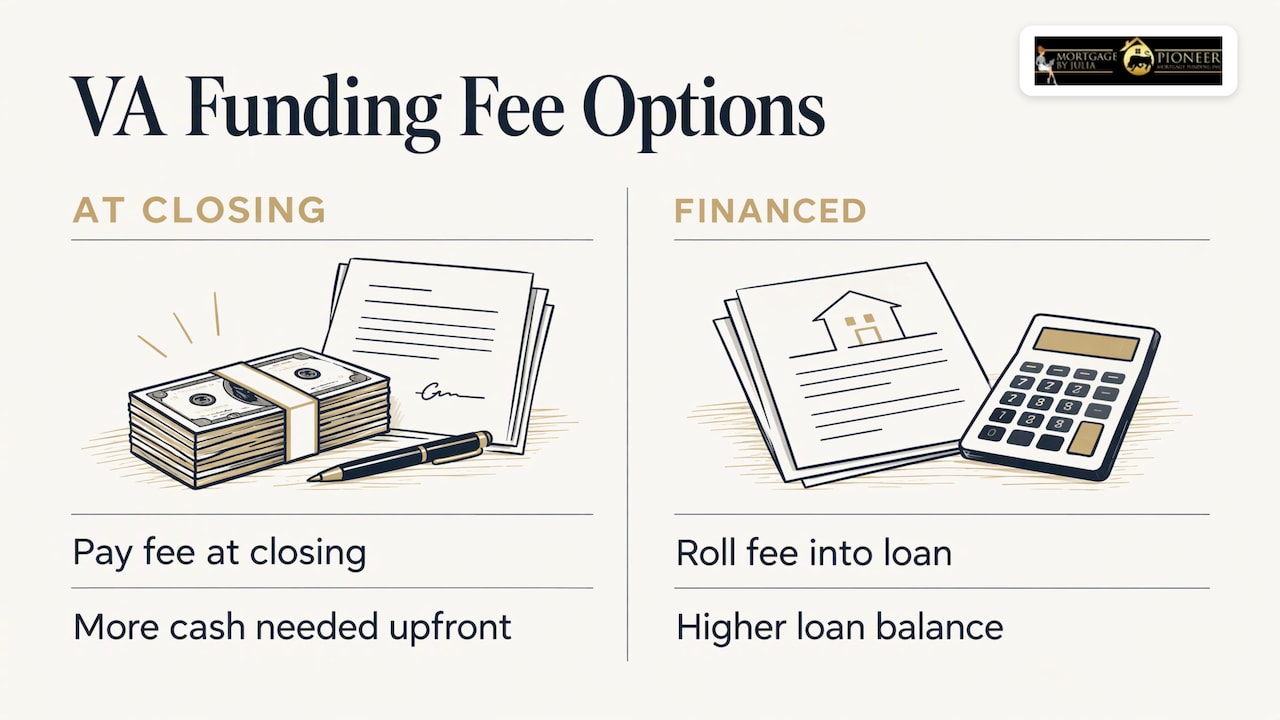
The fee can be paid at closing or rolled into the loan amount. Rolling it in lowers your cash needed upfront, but it increases the balance you finance. We work with VA borrowers in Florida, and you can see the program details on our VA home loans page.
3. Use a piggyback loan
A piggyback structure, often called an 80-10-10, combines an 80% first mortgage, a 10% second mortgage and a 10% down payment. Because the first mortgage sits at 80% of the value, it does not require PMI on the conventional loan. The trade-off is a second loan with its own rate and payment, so the comparison is between that second payment and the PMI you would have paid.
This structure suits buyers with strong credit and about 10% to put down who want to keep the first loan clean. Availability and pricing vary between lenders, which is where comparing several lenders matters.
4. Choose lender-paid mortgage insurance
With lender-paid mortgage insurance, there is no separate monthly PMI line. Instead the cost is built into a higher interest rate on the loan. Because the cost lives in the rate, it generally stays for as long as you keep that loan, unlike borrower-paid PMI that falls away as equity builds. Removing it later usually means refinancing.
This can work well if you expect to hold the loan for a limited time, or if you prefer the lowest possible monthly payment from day one. A side-by-side comparison of the payment, the rate and the total cost over your expected holding period will show whether it beats paying PMI and cancelling it later.
Quick comparison
| Option | Monthly insurance? | What replaces it | Best fit |
|---|---|---|---|
| Conventional, 20% down | No | Larger down payment | Buyers with ample cash |
| VA loan | No | One-time funding fee (some are exempt) | Eligible veterans and service members |
| Piggyback (80-10-10) | No on the first loan | A second mortgage payment | Strong credit, about 10% down |
| Lender-paid insurance | No separate line | Higher interest rate | Lowest payment, shorter holding period |
| FHA | Yes | Not avoidable | Lower credit or smaller down payment |
| USDA | Yes | Upfront and monthly fees | Eligible rural and suburban areas |
Can you get an FHA loan with no PMI?
No. The CFPB states that mortgage insurance is required on all FHA loans. FHA mortgage insurance is called MIP rather than PMI, and it has an upfront portion and an annual portion.
It also behaves differently from conventional PMI. For FHA loans originated on or after June 3, 2013 with less than 10% down, MIP generally lasts for the life of the loan, and the usual way to end it is to refinance into a different loan. That is worth planning for if you choose FHA.
That said, FHA is often the right tool. The CFPB notes that for borrowers with lower credit scores or a smaller down payment, FHA loans can often be the cheapest option, and that borrowers should compare total costs rather than rely on a rule of thumb. We offer FHA loans among our loan programs, and if you later want to lower your payment on an existing FHA loan, an FHA streamline refinance is one path to look at.
What about USDA loans?
USDA loans offer zero down payment for eligible borrowers in eligible areas, and many suburban areas qualify, not only rural ones. They do carry insurance. The CFPB explains that USDA loans require insurance at closing and monthly, and that the upfront portion can be rolled into the mortgage, which raises the loan amount and total cost.
So a USDA loan is a low-cash route, not a no-insurance route. If you are weighing it, our USDA home loans page shows how the program works for Florida properties.
When PMI goes away on its own
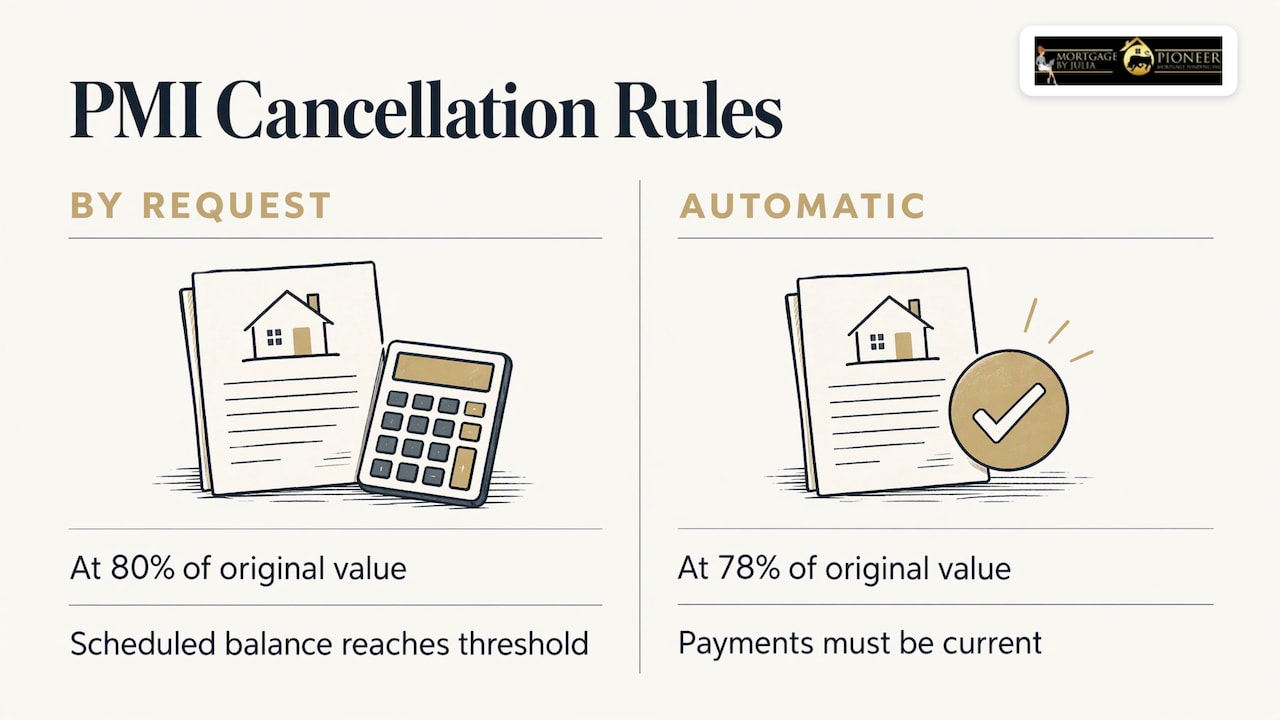
PMI on a conventional loan is temporary, which changes the math on paying it. Under the federal rules for covered single-family primary-residence mortgages, the CFPB says you may request cancellation when your scheduled balance reaches 80% of the original value, and servicers generally must terminate it automatically at 78% if your payments are current. Fannie Mae makes the same point from the borrower’s side: PMI is not forever, and it can come off when you reach 20% equity.
This is why a conventional loan with a small down payment and PMI can be a sound plan. You start with less cash tied up, and the insurance comes off as you pay down the loan or as the home’s value rises. If you are asking how to get to that point faster, extra principal payments help, and so does a refinance if values have risen. Our refinance programs include rate-and-term refinancing, which is one way homeowners reset their loan once they have built equity.
How to choose: a five-step process
- Count your real cash. Add the down payment, closing costs and reserves you want to keep after closing. A larger down payment that leaves you without a cushion is not a win.
- Check your eligibility for VA and USDA. If you qualify for VA, it usually deserves a close look first because there is no monthly mortgage insurance. For USDA, the property location matters.
- Price each structure side by side. Ask for the payment, rate and cash to close on 20% down, PMI with later cancellation, a piggyback structure and lender-paid insurance. Our mortgage calculator lets you test your numbers, and today’s rates give you a starting point.
- Match the loan to your timeline. Staying five years points to a different answer than staying twenty. Lender-paid insurance and piggyback loans look different over those spans.
- Factor in how you earn. Self-employed borrowers and international buyers often need programs beyond standard conventional guidelines, such as bank statement or foreign national loans. Qualifying income and insurance decisions are linked, so settle the loan program first.
A worked comparison
Take a $400,000 purchase with 10% down, so a $360,000 loan. These are illustrative structures, not quotes:
- Conventional with PMI: lowest rate, but a monthly PMI charge that drops off once you reach the cancellation threshold.
- Piggyback: a $320,000 first mortgage and a $40,000 second mortgage. No PMI, but two payments, and the second loan usually carries a higher rate.
- Lender-paid insurance: one loan and one payment with a higher rate and no PMI line, which stays with the loan unless you refinance.
Which wins depends on the actual quotes. That is the practical reason to compare several lenders for the same borrower, rather than accepting the first structure offered.
Where we fit in
Mortgage By Julia offers home purchase loans, refinancing, jumbo, FHA, VA, USDA and conventional programs, along with options for international and self-employed buyers, across Florida. We match each client with suitable loan programs from a broad range of lenders, so a no-PMI question becomes a comparison of real structures instead of a single quote. Our home purchase loans start with your numbers: down payment, credit, income type and timeline.

If you are a first-time buyer, our first-time home buyer page explains the programs and the steps from pre-approval to closing.
Our perspective
Most buyers who ask us about no PMI are really asking how to lower their monthly payment without hurting their long-term position. PMI is one line in that picture, and removing it can mean a bigger down payment, a second loan or a higher rate. We think the honest answer is to put each version in front of you with the full numbers.
Our approach is to work with a broad range of lenders so we can match you with the program that suits your situation, whether that is a conventional loan, VA, FHA, USDA or a program built for self-employed and international buyers. We take particular care with borrowers whose files are not standard, because that is where clear communication and personal guidance matter most.
Before you commit to any structure, ask what your payment looks like today, what it looks like in five years, and what it costs to change later. If those answers are clear, you are choosing with confidence.
Julia Zhguleva
FAQ
Can you get a conventional mortgage with no PMI and less than 20% down?
Yes, through a piggyback loan or lender-paid mortgage insurance. A piggyback uses a second mortgage to bring the first loan to 80% of the value. Lender-paid insurance removes the separate PMI payment but builds the cost into a higher interest rate.
Do VA loans have PMI?
No. The VA states that VA home loans do not require PMI or MIP. Most borrowers pay a one-time funding fee instead, and the amount depends on factors such as service type, down payment and whether it is your first VA loan. Veterans with a service-connected disability rating may be exempt from the fee.
When does PMI come off a conventional loan?
You can generally request cancellation when your balance reaches 80% of the home’s original value, and the servicer must usually end it automatically at 78% if you are current on payments. Reaching 20% equity through payments or appreciation is the common route. Ask your servicer what documentation they need.
Is mortgage insurance on an FHA loan the same as PMI?
Not exactly. FHA loans use MIP, which has an upfront charge and an annual charge, and it is required on every FHA loan. On loans originated on or after June 3, 2013 with less than 10% down, it generally lasts for the life of the loan, so removing it usually means refinancing.
Sources
- What to Know About PMI | Fannie Mae
- FHA loans | Consumer Financial Protection Bureau
- What is mortgage insurance and how does it work? | Consumer Financial Protection Bureau
- When can I remove private mortgage insurance (PMI) from my loan? | Consumer Financial Protection Bureau
- Purchase Loan | Veterans Affairs